
Key figures
Key figures
Key non-financial figures
| Energy transition | Emissions | Circularity | Security of supply | Safety | Diversity |
|---|---|---|---|---|---|
| Reduction forecast for our network users by 2030: 7,8 Mt | CH4 emission reduction: On track | 22.6% circular steel | Uncontrolled events: 2 | TRFI: 2,2 | 25% women in management positions |
| Reduction forecast for our network users by 2035: 22,3 Mt | Scope 1 and (market-based) Scope 2 reduction: Challenging | Transmission interruptions: 2 | |||
| Green CAPEX: 41% | Scope 3 reduction: Not on track |
Achievement of our goals and forecasts
Energy transition
For the years through to 2030, we will not be able to reduce emissions by the amount we thought we could a year ago. As things stand, we believe that our energy transition projects in the Netherlands will enable users to cut carbon emissions by 7.8 Mt by 2030, compared to our estimate of 16.4 Mt in last year’s annual report. We have revised the estimate down to 7.8 Mt because we expect delays to our Aramis CCS project following an objection filed against the permit. As market uptake of hydrogen has been slow to get off the mark, we have downgraded our estimation of the emission reductions users of our German energy transition projects (Hyperlink 1-5) can achieve from 4.4 Mt to 1.3 Mt by 2030.
Emissions
In 2025, we stayed on track to meet our methane emission target for 2030, primarily thanks to greater stability in our operations, which has brought down our uncontrolled emissions. In achieving our Scope 1 and Scope 2 targets, we face challenges, partly due to emissions from the EemsEnergyTerminal, which may become structural as a result of the extension of its deployment. At the time our Scope 1 and Scope 2 targets were set, the EemsEnergyTerminal did not yet exist. Our Scope 3 emissions increased this year, primarily due to the procurement of steel at the end of 2025 to facilitate the construction of several large projects in Germany.
Circularity
In 2025, 22.6% of the steel we procured was made of recycled materials (2024: 12.6%). Thanks to better insights into the production methods of our steel suppliers and improved data collection (using Environmental Product Declarations (EPDs) and other sources), we are able to establish this increasingly accurately.
Security of supply
In 2025, we provided a high level of transport security for our customers. There were two transmission interruptions (2024: 1, internal requirement ≤6) and two uncontrolled events (2024: 0, internal requirement ≤2).
Safety
Gasunie uses its Total Recordable Incident Rate (TRIR, per million hours worked) as a threshold value for safety. Our TRIR improved in 2025 compared to 2024 and is below the threshold value of 2.5.
Diversity
By the end of 2025, there were 208 employees in management positions, of whom 157 were male and 51 female, putting the percentage of women in management positions at 25% (2024: 28%). Gasunie has set the target that 30% of the total management population must be female by 2030.
Transmission performance
Netherlands
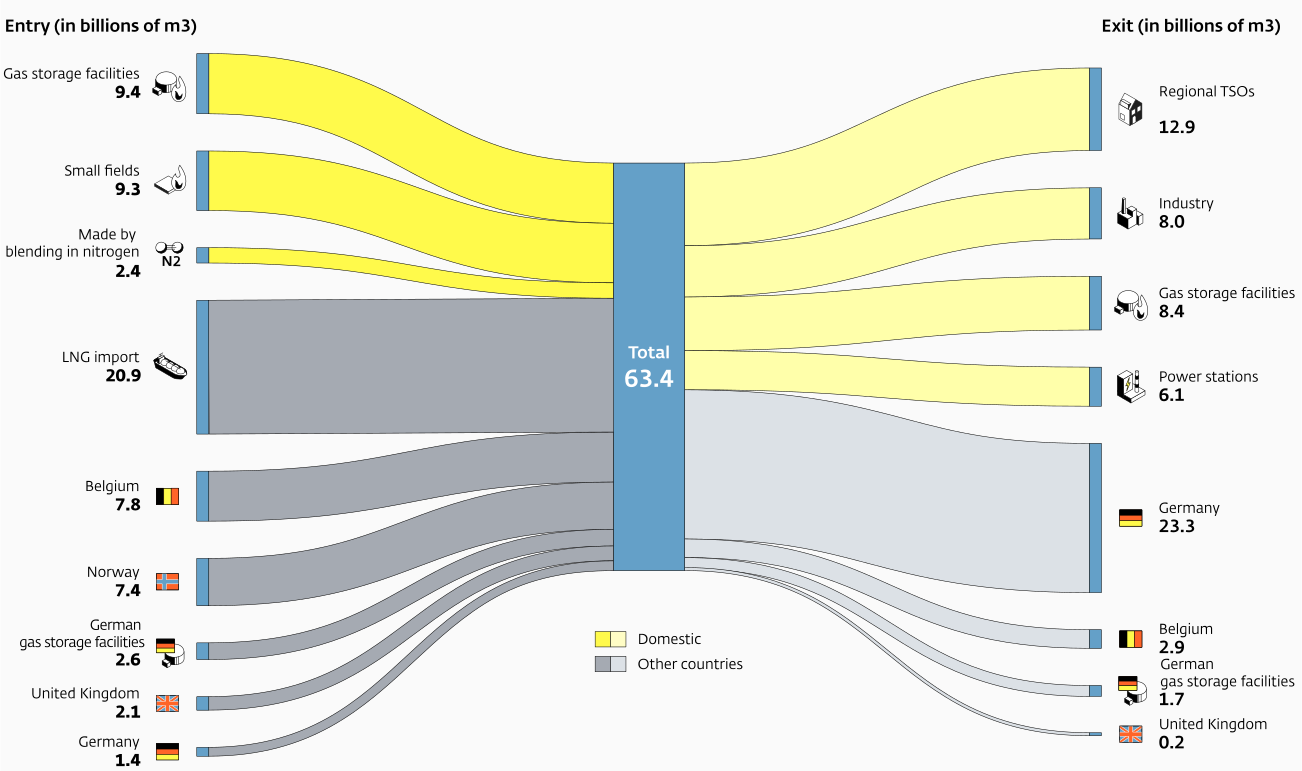
2025 saw Gasunie Transport Services transport 6.2% more natural gas than in 2024. In total, the network operator transported 63.4 billion m3 of natural gas (2024: 59.7 billion m3), providing 685 TWh (2024: 639 TWh) of energy. The increase was largely due to more gas being stored in gas storage facilities, power stations consuming more gas and more gas being exported to Germany. Total domestic gas consumption was practically the same as in 2024 (a 0.3% decrease).
The figures conceal a clear shift. Gas transport to industry fell due to a 9% drop in demand, while consumption by power stations rose by over 17%. Electricity producers turned to natural gas more often to absorb fluctuations in solar and wind production. During cold, dark winter days in particular, when there was little sun or wind, record volumes of gas were transported to power stations to maintain electricity production. This meant that in 2025, natural gas played a more important role as a flexible energy buffer than in 2024, and helped to ensure energy security when it comes to electricity.
Cross-border transport was up 8.2%, largely due to an increase in exports to Germany. Transport to Belgium was down. The strong growth in imports of liquefied natural gas (LNG) is striking. For the first time, more LNG was imported than gas through pipelines (including from Norway). LNG imports rose by some 25.3%, representing an increase of 4.2 billion m3. Furthermore, a record volume of 2 billion m3 of LNG was imported in May – the highest monthly import figure ever.
In 2025, 21% more gas was transported to Dutch gas storage facilities. Injection into German storage facilities (directly connected to the GTS network) also increased (+26%). Although more gas was injected into the storage facilities during 2025 than in the previous year, the facilities were less full than in 2024 at the start of this winter. This is because the gas storage facilities were relatively empty in spring 2025.
Biomethane feed-in rose sharply by 51.2% in 2025, In 2025, a total of 46 million m3 of biomethane was fed into the GTS network. This biomethane came from biomethane feed-in parties that feed directly into the GTS network and the biomethane booster, which transports biomethane from the network of a regional TSO to the GTS network.
Germany
The total amount of natural gas that GUD transports on an annual basis is greater than the sum of the entry volumes shown above. GUD’s gas transmission network is linked to those of other German gas transport companies. The volumes shown represent GUD’s share in the volumes stated in the ‘nominations’ (i.e. shipper’s requests) at the entry points.
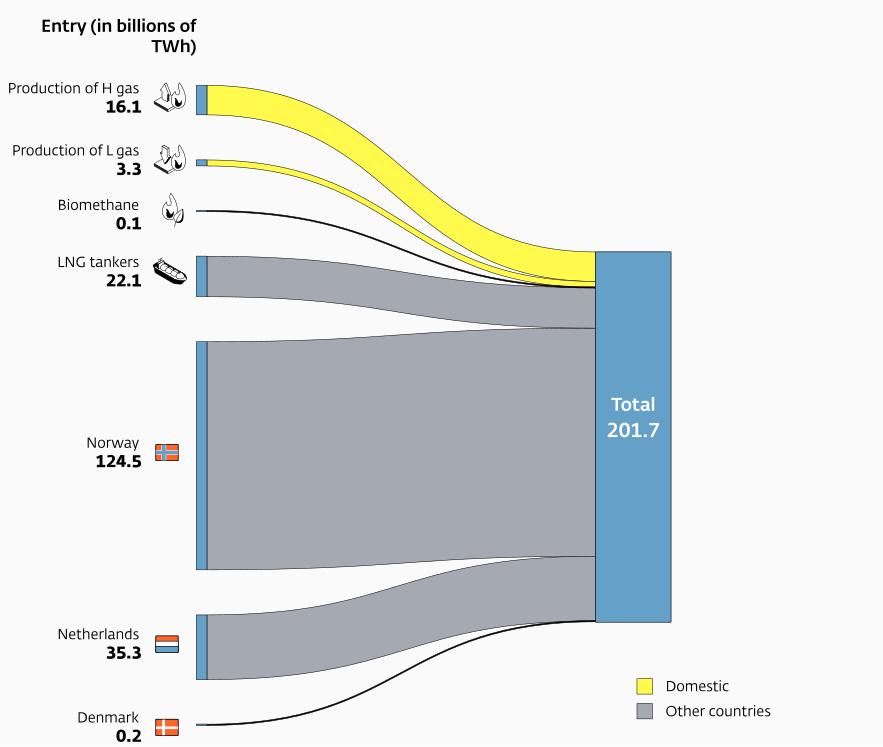
In 2025, Gasunie Deutschland transported 271 TWh (27.7 billion m3) of gas through its network, an increase of 9.3% compared to the 248 TWh (25.4 billion m3) transported in 2024. Imports of natural gas from the Netherlands and Norway rose by 18.4% and 13.3% respectively. The volume of LNG entering the GUD network was stable year on year.
GUD temporarily decommissioned several natural gas pipelines in 2025 to prepare these for hydrogen transport. Because these decommissionings took place in the summer, they had no impact on transmission capacity.
TTF
TTF was established in 2003 by Gasunie Transport Services (GTS) as the central virtual point in the Dutch gas transmission network where gas can ‘change hands’. Rather than a physical exchange, TTF is a virtual hub within GTS’s national gas network where market parties can trade gas that is already in the system (entry-paid gas). TTF prices have become the most important European reference prices for natural gas.
In 2025, more gas was traded on TTF than in the record year 2024. The number of parties trading on TTF also grew compared to the previous year. There are two main forms of gas trading transactions: over the counter (OTC) transactions, where the gas is purchased directly from the other party, and transactions through a gas exchange, which acts as the intermediary for all traders. OTC trading was up almost 22% in 2025, from 15,499 TWh in 2024 to 18,894 TWh this reporting year. The TTF share traded through gas exchanges increased by nearly 16% year-on-year, from 50,509 TWh in 2024 to 58,361 TWh in 2025.
| In TWh | 2025 | 2024 |
|---|---|---|
| Amount of gas traded on the TTF | 77,255 | 66,008 |
| Amount of gas trough the GTS network via TTF | 443 | 437 |
| Maximum number of active parties in one day | 173 | 166 |
TTF retains its great lead over the other European gas trading platforms. Like in previous years, roughly 80% of all European gas trading took place on TTF in 2025, which again confirms that the Dutch gas market is working well and that TTF has acquired a leading position in Europe.
Key financial figures
| Reported | Underlying | |||
|---|---|---|---|---|
| In millions of euros | 2025 | 2024 | 2025 | 2024 |
| Revenu | 1,602 | 1,294 | 1,666 | 1,572 |
| Expenses (excl. deprecation and impairments) | -986 | -834 | -892 | -744 |
| EBITDA | 617 | 461 | 774 | 828 |
A large part of Gasunie’s income comes from the TSOs GTS and GUD, who work with regulated rates. If our revenue from regulated services is higher than permitted in a given year, we must return the surplus to the market (‘settle it’) several years later by charging lower tariffs, and if revenue is lower, the same applies in reverse. This mechanism also applies to energy costs: if these deviate from the standard they are also settled.
The overview above presents both the reported (‘accounting’) EBITDA and the EBITDA adjusted for settlements from the past and expected future settlements. The difference between reported and underlying EBITDA relates, among other things, to lower or higher capacity sales and energy costs than determined by the regulator, as well as higher or lower compensation for our cost of capital. Our performance in 2025 is better reflected by this indicative underlying result.
In 2022, GTS and GUD saw extremely high revenue due to the geopolitical situation. A large part of the higher revenue was settled with our customers in 2024 through our tariffs, which led to a lower reported result for 2024. The remaining part of the higher revenue from 2022 was returned to the market through the tariffs charged in 2025, which slightly dampened the reported result for 2025. The underlying result has been adjusted to reflect these effects.
Revenue
The underlying revenue was € 94 million higher than in 2024. This increase came among other things on the back of expansions to the German natural gas network. Furthermore, the regulatory framework was changed and BBL’s revenue was considerably lower than in 2024.
Reported revenue was € 308 million higher than last year. In 2025, capacity bookings came in approximately € 170 million lower, while higher regulated tariffs generated around € 525 million more in revenue. The tariffs rose in 2025 mainly because they had been low in 2024, as a large part of the surplus revenue from 2022 was returned to consumers through lower tariffs.
EBITDA
The underlying EBITDA decreased by € 54 million compared to last year. This is due not only to the revenue developments described above, but also primarily to workforce growth. Network maintenance costs have also gone up, as have costs relating to the energy transition. The EBITDA increased by € 156 million compared to last year.
Result after tax
Reported profit after tax amounted to € 85 million, an increase of € 15 million compared with 2024. In 2025, an impairment charge of € 141 million was recognised on the property, plant and equipment of Gasunie Deutschland. The review of the valuation of property, plant and equipment was prompted by changes in the regulatory framework applicable to Gasunie Deutschland. In addition, a number of non recurring tax effects resulted in a tax benefit of € 52 million recognised in the income statement. These include, among other things, a gradual reduction in the future corporate income tax rate in Germany and tax incentives related to investments in the energy transition.
| In millions of euros | 2025 | 2024 |
|---|---|---|
| Balance sheet | ||
| Fixed assets | 11,257 | 10,490 |
| Equity | 6,494 | 6,401 |
| Balance sheet total | 11,801 | 11,048 |
| Cash flow statement | ||
| Cash flow from operating activities | 600 | 323 |
| Cash flow from investment activities | -1,240 | -753 |
| Cash flow from financing activities | 601 | 202 |
| Net cash flow | -39 | -228 |
Cash flows
The operational cash flows increased by € 277 million compared to 2024, among other things by the higher EBITDA in 2025. The increase in cash flow from investments came mainly from investments in WarmtelinQ, Porthos and the German gas infrastructure. Compared with 2024, cash flow from financing activities increased mainly due to the raise of new financing and the fact that no dividend was paid to our shareholder in 2025.
Financial outlook
We expect the EBITDA and the net result for the coming years to increase once again compared to the result for 2025.
Several energy transition projects are currently underway. We expect to make new investment decisions for energy transition projects in the coming years.
Gasunie is set to repay a € 650 million bond loan in the second half of 2026. In 2028, Gasunie will repay the EIB for another bond loan of € 300 million.
Regulation
Netherlands
In late 2025, ACM, organisations representing network users, and the joint transmission system operators reached an agreement on the tariff regulation method for gas and power network operators for the 2027-2031 period. ACM uses the tariff regulation method to lay down how tariffs are set and how the efficiency of GTS is assessed. It is the first time that such a sector-wide agreement has been made.
From 2027 onwards, the tariff regulation method will give GTS a financial basis from which they can keep providing reliable gas transport and ready the gas transmission network for the energy transition. Under the new method, ACM will assess the efficiency of GTS based on cost monitoring and process audits. Aside from that, ACM will switch to basing GTS’s permitted revenue on actual, efficient costs incurred rather than on historic costs, as is done under the current method. In order to prevent a spike in GTS’s transport tariffs in 2027 and ensure a more stable development of tariffs, payables arising from cost reconciliations for the current regulatory period will be spread out over multiple years.
It was also agreed that organisations representing network users would be more closely involved in drafting the investment plans of transmission system operators, and at an earlier stage. ACM will be reviewing investment plans more extensively. GTS has agreed to decommission parts of the gas transmission network that are no longer needed for gas transport. Pipelines may, for example, be sold to Hynetwork for the development of the national Dutch hydrogen network. Since choices regarding when certain parts of the gas transmission network should be decommissioned will affect transport tariffs, GTS discloses its reasoning behind these divestments in its investment plan. GTS will start including these divestments in the investment plan from 2028.
In February 2026, ACM adopted a final method decision based on the agreements reached, so that the transmission system operators’ tariffs for the coming years can be determined according to this new method.
Transport tariffs for 2026
In early 2025, ACM set the transport tariffs for 2026, increasing them by an average of around 50%. This increase is related to the higher permitted revenue to compensate, among other things, for higher energy costs and a drop in capacity bookings. It will have a limited impact on household energy bills because GTS transport tariffs make up only a small part of the total energy bill.
Germany
German regulatory authority BNetzA has set the return on equity for the 2023-2027 regulatory period at 5.07% pre-tax for new assets and 3.51% pre-tax for old assets. Together with several other TSOs, GUD filed an objection to this with the court and in 2023 the Düsseldorf Higher Regional Court ruled in favour of the network operators and annulled the tariffs set by the regulatory authority. BNetzA appealed the decision to the German Federal Court of Justice and the appeal succeeded on most points.
In 2025, GUD teamed up with several other TSOs to file a complaint against the efficiency factor for gas set by the regulatory authority. Early in 2022, BNetzA started evaluating a new general efficiency factor that will apply to all TSOs and DSOs during the 2023-2027 regulatory period. BNetzA subsequently published a draft decision in 2023, setting the efficiency factor for gas at 0.87%. The complaint is still pending.
A decision was made in 2025 to apply both KAlkulatorische NUtzungdauer 1.0 (KANU 1.0) and KANU 2.0 from 2026 onwards, which allows for accelerated regulatory depreciation to limit residual value risks, in line with the German government’s goal of reaching climate neutrality by 2045.
In late 2025, BNetzA published the new final commercial regulatory framework for gas TSOs and DSOs that will take effect in 2028. Within this model, the WACC methodology is introduced, among other things, and inflation indexation on capital cost compensation is discontinued. Details of the regulatory framework’s structure will follow. This step builds on previous developments. In 2024, BNetzA initiated proceedings to replace the incentive regulation and network tariff regulations with its own provisions, in line with a European Court of Justice ruling from 2021. After the Court ruled that the German legislator had restricted BNetzA’s powers in violation of EU law, new legislation came into force at the end of 2023 granting BNetzA more decision-making powers.
BNetzA is responsible for designing the regulation for the ‘Kernnetz’, i.e. Germany’s hydrogen backbone. BNetzA has meanwhile established commercial preconditions, which include rules for the setting of tariffs (‘WANDA’), rules on permitted revenue and an intertemporal amortisation account. In terms of network access, BNetzA has already published several decisions, including on network access (‘WaKandA’), balancing (‘WasABi’) and multipliers and discounts for hydrogen transport. The regulatory framework will be fleshed out further in consultation with the market. GUD is closely involved in these consultation processes through the FNB Gas and BDEW trade associations.
Regulatory settlements
As transmission system operators with a monopoly position, GTS and Gasunie Deutschland come under the regulatory purview of the Netherlands Authority for Consumers and Markets (ACM) and Bundesnetzagentur (BNetzA) respectively. These regulatory authorities determine how much GTS and Gasunie Deutschland may earn (the revenue cap), thus guaranteeing that GTS’s and Gasunie Deutschland’s customers are charged reasonable transport tariffs.
If revenue from regulated services is higher than permitted in a given year, the surplus must be returned to the market (‘settled’) several years later by charging lower tariffs, and if revenue is lower, the same applies in reverse. This mechanism also applies to energy costs and other elements from the regulation methodology: if these deviate from the standard they are also settled.
Under the International Financial Reporting Standards (IFRS) for large companies, these settlements may not be recognised as receivables or debt in the balance sheet. These settlements are therefore not recognised in the year in which they arise, but rather in the year in which they are implemented in the tariffs. This gives a distorted picture of the financial result in any given year. Due to the large size of the regulatory settlements, we also present an underlying result in the key figures.
| In millions of euros | 2025 |
|---|---|
| Gasunie Transport Services | |
| To be settled on January 1 | 339 |
| Regulatory settlements paid this year to compensate for previous years | - |
| Settlements to be received in future | 315 |
| To be settled on December 31 | 654 |
| Gasunie Deutschland | |
| To be settled on January 1 | -18 |
| Regulatory settlements paid this year to compensate for previous years | -8 |
| Settlements to be received in future | -44 |
| To be settled on December 31 | -69 |
The tariffs for 2025 included a set-off of € 8 million from previous years. This amount consists of a net settlement of nil for GTS and a positive settlement of € 8 million for Gasunie Deutschland. The revenue achieved, energy costs incurred and investments made in 2025 deviate from the standard set by the regulatory authorities in the Netherlands and Germany. Along with prior-year effects that are yet to be settled, this will result in a future receivable of € 315 million for GTS and a future payable of € 44 million for Gasunie Deutschland. These amounts will be set off in the tariffs in subsequent years.
As at year-end 2025, a regulatory settlement for a sum of € 586 million needed to be made. This sum consists of € 654 million to be received by Gasunie Transport Services and € 69 million to be paid by Gasunie Deutschland. These are estimates; the regulatory authorities ultimately determine the final settlements. In the table below, we have broken down the amounts to be settled by the periods in which the amounts will be settled through the tariffs on the basis of IFRS policies:
| In millions of euros | Total | 2026 | 2027 > |
|---|---|---|---|
| Amounts to be settled by maturity at the end of 2025 | |||
| Gasunie Transport Services | 654 | 339 | 315 |
| Gasunie Deutschland | -69 | -30 | -39 |
| Total to be settled | 586 | 309 | 277 |
Since this settlement is spread out over multiple years as further details are added to the sector agreement to which GTS is a party, it is subject to change.