
Emissions
Emissions
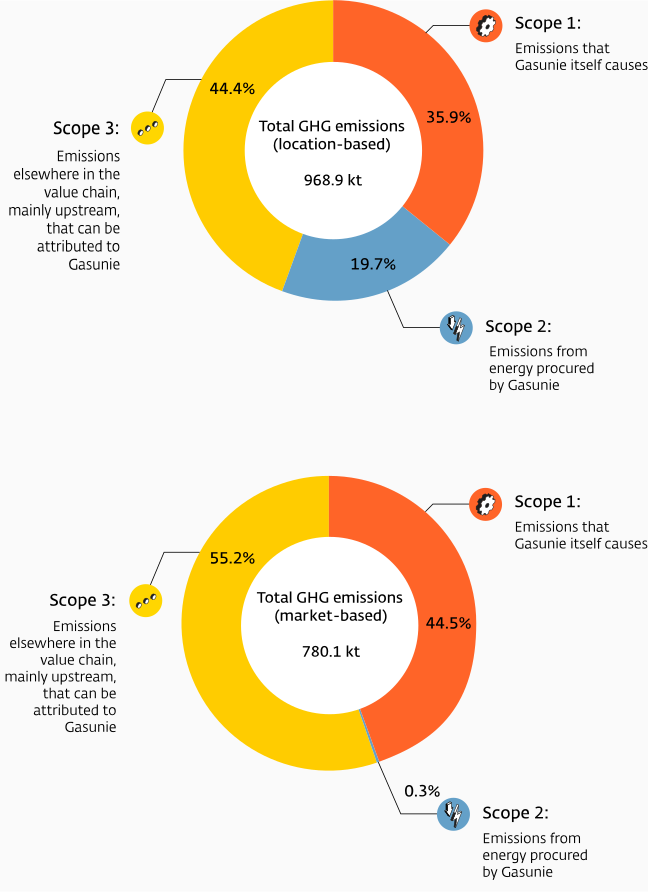
The main contribution Gasunie is able to make to decarbonisation is to enable industry, power companies and households in the Netherlands and north-western Germany to become more sustainable. We do this by transporting increasing volumes of sustainable gases, while at the same time phasing out fossil gases. As we work on this over the coming decades, we also have to cut our own emissions based on the benchmarks from the Paris Agreement. We generate Scope 1, 2 and 3 carbon emissions through our operations.
A closer look at our emissions
- Scope 1 We use energy to keep our networks at the correct pressure, to blend natural gas with nitrogen and to compensate for frictional losses during transport. Gasunie uses electricity and natural gas for this. Combustion of natural gas produces CO2 emissions. Furthermore, methane (natural gas) is emitted to the air during management and maintenance work on our infrastructure.
- Scope 2 We procure electricity for our electric compressors and for the production of the nitrogen we use to convert high-calorific gas from outside the Netherlands and from the North Sea fields into Groningen quality low-calorific gas (‘pseudo G-gas’). Scope 2 also includes the electricity consumed in our offices and our installation buildings.
- Scope 3 emissions arise from the production of goods and services we procure, such as steel tubes and other materials. The use of machines and means of transport on construction sites also generates emissions.
We disclose both our location-based and market-based emissions.
- Location based This figure is based on the GHG emissions caused by the generation of electricity in the region where the electricity is used. The location-based figure is calculated by multiplying the electricity consumption (in kilowatt-hours, kWh) by the applicable CO2 emission factor.
- Market based This figure is calculated based on the greenhouse gas emissions of the energy installations where the procured electricity originates. We prove the origin of the electricity (from renewable sources) through Guarantees of Origin (GOs),
Impacts, risks and opportunities
The carbon emissions we cause directly and indirectly result in the following impacts, risks and opportunities, as shown by our double materiality assessment:
| No. | ESRS | Material topic - ESRS | IRO |
|---|---|---|---|
| 1 | E1 | Climate change mitigation | Actual negative impact: Gasunie's operations and the activities within our value chain lead to the generation of greenhouse gas emissions, which contribute to climate change. |
| 2 | E1 | Climate change mitigation | Transition risk: In the event of the EU or other authorities setting stricter requirements, methane and other greenhouse gas emissions (CO2) from Gasunie's operating activities will entail financial consequences in terms of penalties, fines or other costs. |
| 3 | E1 | Energy | Actual negative impact: Gasunie's own operations require a large amount of fossil fuels, which contributes to climate change. |
We have identified and assessed the relevant climate and transition risks. This assessment was performed without using a scenario analysis, although we do acknowledge that scenario analyses are an important risk assessment tool. At this point in time, we do not know whether or not the efforts we are planning to cut our own emissions will be enough to reduce our contribution to global warming to a sufficient degree.
Policy
Gasunie has adopted a general greenhouse gas emission reduction policy that sets out goals and provides management information. Wherever specific policy is in place, we will refer to it. Examples of such specific policy include our policy focused on improving energy efficiency and reducing methane emissions. These policies apply to all Gasunie-operated energy-consuming capital goods (assets). This includes not only Gasunie-owned assets, but also assets owned by associate entities or third parties for which we have operational responsibility. Our policy classifies emissions based on the Greenhouse Gas (GHG) Protocol and we aim for net-zero CO2e, as defined by SBTi, in our own operations.
Climate Transition Plan
Due to organisational changes, Gasunie did not yet have a fully developed climate transition plan in 2025. Work on the transition plan will continue, but no progress was made over the period under review. Our aim is to reach net-zero GHG emissions across all three Scopes by 2045, if reasonably possible. The detailed transition plan is intended to ensure that the goals remain feasible and affordable. Reaching net zero boils down to a 90% reduction compared to the reference year 2020. The remaining 10% will be neutralised through ‘carbon removals’, i.e. the physical removal of CO2 from the atmosphere and long-term storage.
As soon as Gasunie has a fully specified and feasible climate transition plan, we will convert our net zero ambition into a formal net zero goal for 2045. If we reach this goal by 2045, we will have ceased to contribute to climate change earlier than required under the Paris Agreement (2050). We deem this to be a realistic aim, given the combination of planned emission-saving measures and the expected decrease in the use of our gas transmission networks due to declining demand for gas.
We have not yet conducted an in-depth analysis of potential obstacles in achieving this ambition. Identifying these risks is essential for a prompt response to future challenges. With this in mind, we are going to enrich our reduction plans with such an analysis and incorporate them into the climate transition plan.
While Gasunie does currently have a net zero ambition, it does not yet have a formal net zero goal. We are waiting for a sector-specific reduction framework for the oil and gas sector from the Science Based Targets initiative (SBTi). This framework was under development up to April 2025, but has since been put on hold.
As we wait for this framework to materialise, we are exploring ways to align with the general SBTi guidelines. Under these guidelines, organisations aiming to meet the 1.5°C global warming target from the Paris Agreement have to cut their carbon emissions by 4.2% every year compared to the base year.
For the period through to 2030 (Scope 1 and 2) and 2035 (Scope 3), we have identified the available options and associated investment costs, and included this in our emission reduction plan. However, we do not yet have such a clear picture for the period beyond 2030. Gasunie is committed to delivering a full climate transition plan in the medium term, whereby we will also assess whether the selected base year is still a representative benchmark. The speed at which we can reduce our emissions after 2035 depends on many aspects. For example, we are required by law to guarantee the security of natural gas transmission in the Netherlands and in the part of Germany in which we operate. There is also the fact that the pace of the energy transition is difficult to predict. We are trying to make a better estimate by developing scenarios, for example, in the form of the II3050 scenario studies. We will then review and update the climate transition plan periodically to take into account the addition of new business units, associate entities and emission reduction technologies.
Emission reduction plans
Emission reduction plans form the basis for Gasunie’s future climate transition plan. We have made plans for all three Scopes. Those packages that will deliver the greatest emission reduction at the lowest cost will be carried out first. We developed our first emission reduction plan in 2024, which has since been approved by the Executive Board.
Scopes 1 and 2
For the 2025-2030 period, we have a clear picture of how much emissions we want to and can cut, and what this will cost, in line with the SBTi guidelines. Those packages that will deliver the greatest emission reduction at the lowest cost will be carried out first. In our emission reduction plan, we are aiming to reduce Scope 1 and 2 emissions by 178.1 kt CO2e (2024: 248.5 kt CO2e) by 2030, compared to the base year 2020.
The table below shows which measures we are considering and by how much each one of them will reduce Scope 1 and 2 emissions by 2030. Several changes were made compared to last year, the main ones of which are highlighted below.
Netherlands:
- Heat pumps at gas receiving stations: Due to a shortage of space on the power grid for new connections and unfavourable cost-benefit ratios, installing a heat pump is simply not an option at many of our sites. Where possible, we will only install heat pumps at sites that are subject to an energy efficiency obligation. We will dedicate the coming year to developing a new project schedule (2024: 14.4, 2025: 0).
- Metering instrument quality: An inspection of the quality of metering instruments has given us a better idea of the various technical solutions and which would best suit our business process. Based on these new insights, we have adjusted the solution approach and revised our reduction forecast (2024: 9.5, 2025: 1.7).
- Metering and regulating stations: several pneumatic components have already been replaced, leaving a smaller amount of emissions still to be cut (2024: 16.3, 2025: 14.1).
- Emission reduction at Maasvlakte metering station: a validation calculation of operating emissions shows that the emission reduction target is higher here (2024: 1.5, 2025: 6.1).
- The adjustment to the expected emission reduction prompted a recalculation of the associated capital expenditures.
Germany:
- Electrically driven compression: broken down by Achim West and Rysum. We have had to revise the emission reduction forecast, partly because we expect to have to retain gas-fired compression at Embsen and Rysum alongside the new electric compressors. Gas-fired compression capacity is expected to still be needed as a back-up with reduced operating hours, causing the expected emission reduction to be lower than the previous forecast (2024: 178.8 and 2025: 120.8).
- Static recompression: with additional sites having been brought into scope, the expected reduction is now higher (2024: 1.4 and 2025: 5.8).
- The new insights and adjustments to the expected emission reduction prompted a recalculation of the associated capital expenditures.
Planned measures for Gasunie Nederland:
Estimated investment up to 2030: € 69.9 million4
Expected emission reduction by 2030: 50.8 kt CO2e 5
| Actions Gasunie Nederland scope 1 & 2 | Decarbonization lever | Expected emission reduction by 2030 in kt CO₂eq | Estimated CAPEX up to 2030 in million euros |
|---|---|---|---|
| 1. Emission reduction gas receiving station | Energy efficiency | - | - |
| 2. Leak detection and repair-program (LDAR) | Preventing emissions | 7.6 | - |
| 3. Eliminate ventstack emissions | Preventing emissions | 19.0 | 27.7 |
| 4. Emission reduction metering and control stations | Preventing emissions | 14.1 | 39.9 |
| 5. Emission reduction by quality of the measuring instruments | Technological emission reduction | 1.7 | 0.2 |
| 6. Emission reduction through mobile recompression | Technological emission reduction | 2.2 | 1.2 |
| 7. Emission reduction gsa-operated actuators | Energy efficiency | 0.1 | 0.9 |
| 8. Emission reduction LNG Maasvlakte (blending station) | Preventing emissions | 6.1 | - |
Planned measures for Gasunie Deutschland:
Estimated investment up to 2030: € 382.0 million
Expected emission reduction by 2030: 127.3 kt CO2e
| Actions Gasunie Deutschland scope 1 & 2 | Decarbonization lever | Expected emission reduction by 2030 in kt CO₂eq | Estimated CAPEX up to 2030 in million euros |
|---|---|---|---|
| 1. Installation of electrically driven compressors Achim West and Rysum | Decommissioning assets | 120.7 | 369.6 |
| 2. Emission reduction by mobile recompression | Technological emission reduction | 0.8 | 0.4 |
| 3. Emission reduction by mobile recompression units Emsden | Technological emission reduction | 5.8 | 12.0 |
Scope 3
Our Scope 3 reduction strategy focuses on the largest sources of emissions within our value chain: the procurement of steel, contracting and energy used at the front end of the value chain. We actively work with the main suppliers of steel materials and with contractors to jointly reduce emissions in these parts of the value chain. We expect these emissions to increase as our investment portfolio grows. This growth is necessary to enable the energy transition. Within the Scope 3 reduction programme, we have opted for an economic CO2 intensity target, whereby emissions are measured against expenditure (kg CO2 per euro). This fosters efficient and climate-conscious investments without hindering the progress of the energy transition. The planned measures listed below are based on the analysis carried out in 2024 using emission data for the base year 2023, including the assumptions and the reduction costs as they were at the time. We do not update these figures annually, even though the actual data may change annually from 2025 onwards (such as due to Scope 1 & 2 measures).
Planned measures for Scope 3
Estimated investments required up to 2030: € 150 million6
Potential emission reduction by 2030: 208.1 kt CO2e
| Actions Gasunie Scope 3 (Nederland en Deutschland) | Scope 3 category | Decarbonization lever | Expected emission reduction by 2030 in kt CO₂eq |
|---|---|---|---|
| 1. Installing electrically driven compressors | C3 - upstream energy | Decommissioning assets | 12.0 |
| 2. Installation of heat pumps at gas receiving stations | C3 - upstream energy | Decommissioning assets | 1.0 |
| 3. Reducing emission in ICT investments | C15 - investments | Preventing emissions | 1.0 |
| 4. Reducing emissions from pipeline investments | C15 - investments | Preventing emissions | 0.3 |
| 5. Reducing emissions from Gate terminal investments | C15 - investments | Preventing emissions | 0.3 |
| 6. Increasing energy efficiency of construction equipment | C1 - Purchased goods | Energy efficiency | 32.0 |
| 7. Purchasing renewable energy (Guarantees of Origin) for nitrogen production | C1 - Purchased goods | Preventing emissions | 29.5 |
| 8. Purchasing green steel produced with DRI technology (green gas) | C1 - Purchased goods | Technological emission reduction | 40.0 |
| 9. Purchasing green steel produced with scrap steel - EAF technology | C1 - Purchased goods | Technological emission reduction | 17.0 |
| 10. Purchasing green steel produced with DRI technology (Hydrogen) | C1 - Purchased goods | Technological emission reduction | - |
| 11. Emission reduction through the use of emission-free construction equipment | C1 - Purchased services | Preventing emissions | 75.0 |
Action plans
Gasunie’s emission reduction plans consist (or will consist) of one or more actions. Below we summarise for each Scope the actions we are implementing or developing. These are called ‘decarbonisation levers’, i.e. a strategy or measure that helps reduce carbon emissions.
Scope 1 decarbonisation levers
Scope 1 emissions are all emissions that are a direct result of our own activities. Gasunie’s main focus so far has been to drive back these kinds of emissions. Methane emissions account for a large part of the emissions in this category. These made up 28% of Scope 1 emissions in 2025 (2024: 31%). Methane has a global warming potential of 28. This means that one kilogram of methane (CH4) is 28 times more harmful than a kilogram of CO2. The other 72% of Scope 1 emissions consist mainly of emissions from compressor drive systems, heating buildings and heating up gas at receiving stations. The new EU Methane Regulation that took effect in 2024 requires us to further reduce our methane emissions.
For Scope 1 we are using the following four decarbonisation levers:
| Decarbonization lever | Action | Time horizon |
|---|---|---|
| Energy efficiency | Limiting energy needs | LT |
| Energy efficiency of components | LT | |
| Preventing emissions | Leak detection and repair (LDAR) program | LT |
| Taskforce Emissions | LT | |
| Technological emission reduction | Use of mobile hercompression | ST |
| Displacement with the help of nitrogen | LT | |
| Flaren | MT | |
| Use of mini-hercompression-units | MT | |
| Installation of emission free controllers | ST | |
| Commissioning assets | Replacing gas-powered compressors with electric compressors | MT |
| (Temporary) decommissioning of compressor stations | LT |
Scope 2 decarbonisation levers
Scope 2 emissions are indirect emissions from the energy Gasunie procures. We procure electricity for our electric compressors and for the production of the nitrogen we use to convert high-calorific gas from outside the Netherlands and from the North Sea fields into Groningen quality low-calorific gas (‘pseudo G-gas’). Scope 2 also includes the electricity used in our offices and the buildings housing our installations. Besides electricity we also procure a limited amount of heat, mainly to heat gas at receiving stations. The Scope 2 measures will remain important to us until we cut our emissions to virtually zero or until further reduction is no longer possible; in this we will continue to focus on feasible and affordable reduction measures.
| Decarbonization lever | Action | Time horizon |
|---|---|---|
| Greening of energy source | Greening our own electricity consumption with Guarantees of Origin (Gos) | ST |
| Concluding of Power Purchase Agreements (PPA’s) | ST/MT |
Scope 3 decarbonisation levers
In 2024, we identified all of our Scope 3 emissions for the first time, using 2023 as the base year from which we start calculating reductions. Based on this insight, we have put together a roadmap with measures for Scope 3 emission reduction that we intend to implement along with details of the savings, costs and implementation timeline of these measures. In total, we believe that our maximum Scope 3 emission reduction potential amounts to over 200 kt CO2e (-57%). We expect that we can make this happen through the set of measures outlined below, provided that the external market situation, and then especially the pace of decarbonisation in industry, does not see any major delays and the costs stay within Gasunie’s internal carbon pricing (ICP).
| Decarbonization lever | Action | Time horizon |
|---|---|---|
| Energy efficiency | Installation of heatpumps | MT |
| IT-greening | MT | |
| Emissiereduction of non operated assets | MT | |
| Preventing emissions | Purchasing criteria emissions | MT |
| Sustainable investment policy | LT | |
| Commuting and travel | ST | |
| Technological emission reduction | Production with electric arc furnace technology | MT |
| Production with DRI-technology | LT | |
| Greening of energy source | Emission-free construction sites | MT |
| Greening nitrogen production | ST | |
| Decommissioning assets | Replacing gas-driven compressors | MT |
Resources
As stated previously, Gasunie intends to invest a total of € 10.5 billion over the 2026-2030 period. Of this amount, one quarter is slated for maintenance and expansion of the natural gas infrastructure, which also includes our decarbonisation investments.
Our emission reduction plans are part of EU Taxonomy activity 4.14 ‘Transmission and distribution networks for renewable and low-carbon gases.’ In 2025, € 33 million CAPEX and € 11 million OPEX were included under activity 4.14 relating to emission reduction plans.
Measurable targets
Our 2030 target for methane emissions, our 2030 target for Scope 1 and market-based Scope 2 emissions and our Scope 3 targets for 2030 and 2035 have all been validated by means of a second party opinion provided by an external party (other than the independent auditor) in the context of the Sustainability-Linked Bond framework (2025 edition). We have chosen the base years as the basis for our targets because they provided the most up-to-date and complete picture at the time. Every year, we evaluate the progress of our action plans and make adjustments where necessary to ensure the consistency of our emission reduction target for 2030.
7 The Scope 1 target does not include emissions from the EemsEnergyTerminal, as this terminal was not yet operational when the Scope 1 target was set.
When we set our targets for methane emissions and Scope 1 and market-based Scope 2 emissions, we assumed that the global warming potential (GWP) of one kilotonne of methane was 25 times higher than that of one kilotonne of CO2. However, new scientific insights show that methane is even more harmful. In 2022, the GWP figure was raised to 28. Since we have not adjusted our calculation formula, our reduction target is now more ambitious than originally thought.
Methane emissions
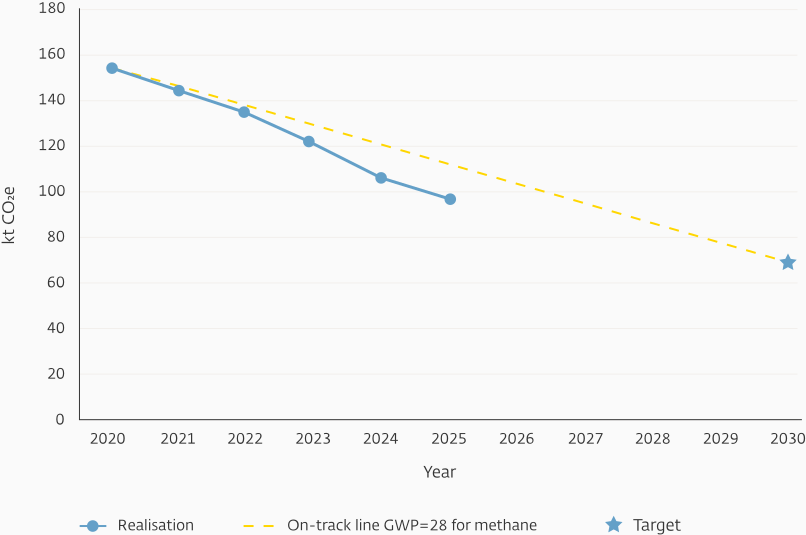
Our methane emissions have to be below 70 kilotonnes (kt) of CO2e by 2030, which boils down to a 49% reduction compared to the base year 2020. Of this 70-kilotonne target, Gasunie’s Dutch assets have to deliver 50 kt and Gasunie’s German assets 20 kt. This target is not subject to how our transport volumes develop.
8 We did not choose 2020 as the base year because it is representative, but because 2020 provided the most recent and comprehensive view of the total emissions across the scopes at the time, i.e. in 2021.
Scope 1 emissions and market-based Scope 2 emissions
The extent of the emissions we produce for natural gas transport through our pipelines depends on the transport volume and direction. With this simple fact in mind, we have set a relative goal for the combination of our Scope 1 and market-based Scope 2 emissions, based on the combined transport volumes of GTS and GUD.
The formula for this is as follows:
CO2e [kt] = 70 [kt CO2e] + (0.137 × transport volume [TWh])
In 2020, we emitted a total of 330 kilotonnes of CO2e across Scopes 1 and 2 (market-based). By 2030, this figure must not exceed 219 kilotonnes, based on the volume of the base year 2020 (1,085 TWh), which means a 34% drop.
Scope 3 emissions
Gasunie has set a relative reduction target that covers 73% of the Scope 3 emissions (in the base year 2023), taking into account the associated procurement. The target focuses on emissions from procured steel, fuel, electricity, nitrogen, investments and procured construction services. Gasunie aims for a 51.6% reduction by 2030 and 66.3% by 2035 (kg CO2e per euro in procurement, compared to 2023). Our Scope 3 ambition level contributes to the mitigation of global warming to under 2°C . We have tested the feasibility of these targets by defining reduction measures and their maximum reduction potential based on market developments and industrial decarbonisation options.
9 The proportion of emissions that fall within our Scope 3 target changed from 77% to 73% following the DEFRA database update that led to a recalculation of figures for the base year 2023.
10 This is known as the WB2D (well below 2°C) pathway (SBTi). The Science Based Targets initiative expects a lower ambition from companies on Scope 3 (compared to Scopes 1 and 2). This is because of the many challenges in reducing emissions across the value chain, such as data availability and lack of influence over suppliers.
This economic intensity target is expressed as kilograms of CO2e per euro spent, creating room for spending to grow while we aim to minimise the impact on the climate. We have calculated our Scope 3 targets using SBTi’s prescribed calculation tool.
Given that we do not own or sell the gas we transport, the emissions from gas usage by third parties are not included in Gasunie’s Scope 3 inventory or target. On this point we deviate from SBTi’s general guidance. That said, we still believe that it is important for us to provide an overview of the climate impact caused by the use of gas by end users. We regularly report on this impact to the Dutch authorities. We have set emissions produced by end users as they burn the natural gas we transported at 193.2 Mt for 2025 (2024: 179.5 Mt CO2e).
Achievement of our goals
Our methane emission target
In 2025, we managed to stay on track to meet our methane emission reduction target. Our methane emissions totalled 96.66 kt CO2e in 2025, compared to 106.1 kt CO2e in 2024. The 9% drop is mainly the result of more stable operations bringing down uncontrolled emissions. Thanks to the expansion of our Leak Detection and Repair (LDAR) programme, we were able to detect, monitor and repair leaks more quickly.
Our Scope 1 and market-based Scope 2 target
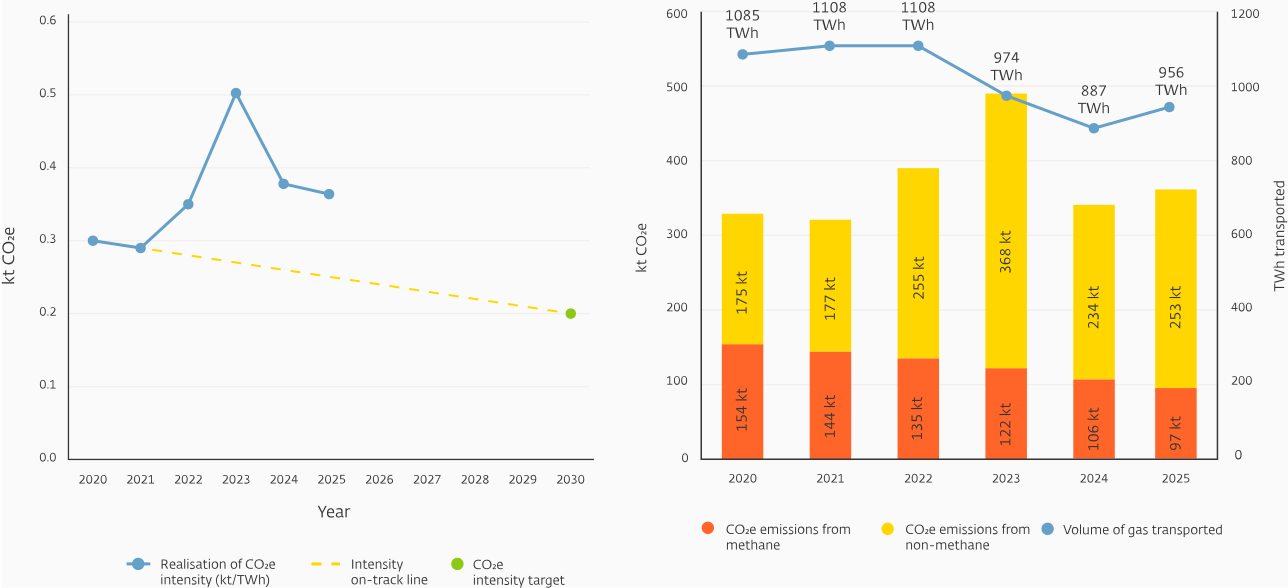
At the time our Scope 1 and 2 target was set, the EemsEnergyTerminal was not yet in operation. The huge amount of energy needed to run this LNG terminal makes it more challenging to meet the targets we have set. Given the continuing need for LNG import capacity, Gasunie and fellow shareholder Vopak intend to keep EemsEnergyTerminal operational for longer. We are aware that keeping EemsEnergyTerminal in operation for longer than initially planned could thwart our ability to hit our emission reduction targets, which is why in 2025 we initiated a study into how a new setup of EemsEnergyTerminal could help reduce emissions. The results of this study are expected in 2026. We have not yet carried out an assessment of the potentially locked-in GHG emissions.
In our market‑based Scope 1 and 2 emissions target, our actual emissions are assessed taking the transported volume into account. Since our absolute emissions remained stable and the volume of natural gas transported increased, our relative emissions reduced with 5% compared to the 2024 level. Although this decrease has occurred, achieving our reduction targets remains challenging. Due to the emissions from the EemsEnergyTerminal, we are seeing a 21% relative increase compared with our base year.
Our Scope 3 target
For 2025, we saw an absolute increase of our total Scope 3 emissions by 62% compared to last year. These emissions increased because of the large number of capital goods purchased for our major projects in Germany and because of larger waste streams, due in part to the abandonment of compressor stations in 2025.
With our relative Scope 3 target, our focus is on emission categories that fall within the established scope of 73% of our Scope 3 emissions in the base year 2023: procured steel, nitrogen, electricity, fuel, investments and construction services. In line with our ambition to reduce these Scope 3 emissions, we are closely monitoring progress in these categories. We have seen these categories increase by 21% compared to the base year, taking into account the associated procurement expenditures. This development can mainly be attributed to the large volume of steel and construction services purchased to be able to facilitate the construction of several major projects in Germany.
ESRS tables for Scope 1, 2 and 3
| in kilotonnes of CO₂eq | 2025 | 2024 | Base year* | % change compared to last year | % change compared to base year | Realisation (% change compared to base year) *** | Target 2030*** | Target 2035*** |
|---|---|---|---|---|---|---|---|---|
| Scope 1 GHG emissions | ||||||||
| Total scope 1 GHG emissions | 347.4 | 340.5 | 329.4 | 2% | 5% | |||
| Percentage of scope 1 emissions from regulated emissions trading systems (%) | 69% | 73% | ||||||
| Scope 2 GHG emissions | ||||||||
| Total scope 2 GHG emissions (location based) | 191.3 | 226.9 | 288.6 | -16% | -34% | |||
| Total scope 2 GHG emissions (market based) | 2.5 | 0.7 | - | 242% | - % | |||
| Total Scope 1 & 2 GHG emissions (market based) | 349.8 | 341.2 | 329.4 | 3% | 6% | 21% | -34% | |
| Scope 3 GHG emissions | ||||||||
| Total indirect scope 3 GHG emissions** | 430.3 | 266.3 | 379.2 | 62% | 13% | 21% | -51.6% | -66.3% |
| (1) Purchased goods and services | 115.0 | 97.6 | 143.0 | |||||
| (2) Capital goods | 245.5 | 104.3 | 173.1 | |||||
| (3) Fuel-related and energy-related activities (not included in scope 1 or scope 2) | 51.3 | 50.9 | 49.8 | |||||
| (4) Upstream transportation and distribution | 1.3 | 1.0 | 1.2 | |||||
| (5) Waste generated in operations | 10.5 | 4.4 | 5.4 | |||||
| (6) Business travel | 1.0 | 1.4 | 1.2 | |||||
| (7) Employee commuting | 1.5 | 1.7 | 1.5 | |||||
| (12) End-of-life treatment of sold products | 0.7 | 0.7 | 0.6 | |||||
| (15) Investments | 3.6 | 4.5 | 3.5 | |||||
| Total GHG emissions | ||||||||
| Total GHG emissions (location based) | 968.9 | 833.7 | 16% | |||||
| Total GHG emissions (market based) | 780.1 | 607.5 | 28% |
Our location-based Scope 1 and Scope 2 emissions from group companies amounted to 281.9 and 148.2 kt CO₂e respectively. For our joint operations and joint ventures over which we have operational control, these emissions amounted to 65.4 kt CO2e (Scope 1) and 43.1 kt CO2e (Scope 2).
The Sustainability Statement Appendix includes details of the judgements and estimates we used with regard to our emissions, as well as information on our energy consumption and the energy mix.