
General
General
In our Sustainability Statement, we provide insight into our environmental, social and governance impacts, risks and opportunities, rendering account on sustainability risks, adverse impacts on sustainability and how we create sustainable value for our stakeholders. While Gasunie has been committed to providing insight on its sustainability credentials in the past, we have been taking a more structured approach to this and adopted fixed guidelines in 2024, following the implementation of the Corporate Sustainability Reporting Directive (hereinafter: CSRD).
About the Sustainability Statement
Basis for preparation
The Sustainability Statement is part of the management report, comprising sections 6 to 12, the Sustainability Statement Appendix and the information included by reference (see the Reference table). The external auditor performed a limited assurance audit of the Sustainability Statement.
The Sustainability Statement relates to the 2025 financial year and was prepared in compliance with the European Sustainability Reporting Standards (ESRS EU 2023/2772, hereinafter: ESRS).
Consolidation
The information recognised in this Sustainability Statement has been consolidated based on the same accounting principles as those underpinning the consolidated financial statements. Any deviations from these policies are explicitly stated.
Judgements, estimates and uncertainties
In preparing the Sustainability Statement, we used estimates and judgements, especially in our forecasts on facilitating emission savings, our calculation of Scope 3 emissions and the determination of our resource inflows.
Where necessary to provide the required disclosure, we have included the nature of the judgements and estimates in the notes to the relevant data or in the Sustainability Statement Appendix.
We review the underlying assumptions of estimates on a periodic basis. The judgements and estimates we have used can be refined in future reporting periods once more relevant information becomes available. In 2025, we further optimised the way we determine our Scope 3 emissions and the way we calculate the total kilograms of steel and the figure for hours worked by contractors that goes into the calculation of our TRIR. In these cases, we have revised the comparative figures. For more information on these optimisations, see the ‘Emissions’, ‘Circularity’ and ‘Safety’ sections.
Resilience analysis
In 2024, we revised our Vision 2030 strategy, which dates back to 2020, describing the resilience of our strategy and our business model when it comes to climate change for the period through to 2030 and through to 2040. This saw us review various climate change scenarios from II3050. In 2025, we tested the results of the 2024 resilience analysis against the current situation as part of the adoption of our business plan for the 2026-2028 period. The results of the analysis have been incorporated into this annual report in the Risk Management sub-section of the Governance section and in the impacts, risks and opportunities for the topics of energy transition and emissions.
Time horizons
The time horizons over which an action or measure will be completed may differ per action or measure. This we make clear by marking the action or measure as ST (short term: one year after the end of the reporting period), MT (medium term: one to five years from the end of the reporting period) or LT (long term/ongoing: over five years from the end of the reporting period or an ongoing action/measure). In doing so, we align with the time horizons from the ESRS.
Our value chains
In the We are Gasunie section, we present an overview of our role in the energy value chain in the Netherlands and northern Germany, providing insight into our own operations (import, transport, treatment and storage), our upstream value chain (source) and our downstream value chain (destination).
Policy and measurable targets
Before releasing it to the internal organisation, the policy set out in the Sustainability Statement was approved by Gasunie’s Executive Board. The Executive Board has ultimate responsibility for policy compliance. Policy regarding security of supply, safety and diversity follows the applicable laws and regulations, such as the Dutch Gas Act, Working Conditions Act and Ingrowth Quota and Targets Act.
The targets included in the Sustainability Statement are approved annually, prior to the financial year, by the Executive Board, which it does by approving the business plan. The business plan is also submitted to the Supervisory Board for approval.
Every quarter, the Executive Board receives a quarterly report with an update on the key risks, opportunities and performance indicators in the area of sustainability, as included in the business plan. Implementation of the business plan is evaluated and discussed on a quarterly basis during the regular meetings of the Supervisory Board.
Stakeholders are not explicitly involved in determining policy, setting the measurable targets, monitoring results or mapping improvements. Wherever they were involved, this is stated with the policy or measurable target.
The attainment of targets as stated in the Sustainability Statement has, in principle, not been validated by an external party other than our independent auditor. If these targets were validated externally, this is stated specifically.
Material topics
In this Sustainability Statement, we focus specifically on the main sustainability subjects for Gasunie stakeholders. To determine which subjects these are, we identified material topics based on the ESRS principle of double materiality:
- Impact materiality: the impact that Gasunie has on people and the environment (the inside-out perspective)
- Financial materiality: risks and opportunities for Gasunie arising on the back of various sustainability-related developments and events (the outside-in perspective)
Results of the materiality assessment
The double materiality assessment (DMA) revealed eight topics that our internal and external stakeholders consider material, i.e. important, for Gasunie. These topics are listed in the connectivity table. For each other these topics, we have made an assessment of both their impact materiality and financial materiality, on top of the estimates by our stakeholders. These eight topics have not been ranked in any way.
In 2025, we revised the DMA by formulating IROs in more specific terms and rating them on an individual basis instead of by (sub-)topic. This led to changes in our material topics and IROs. We also went into greater depth on the substance of the analysis and improved its alignment with our sustainability strategy (CSR strategy) and the internal risk management process. In the Sustainability Statement Appendix, we have outlined the steps that went into our double materiality assessment.
Compared to last year, the topics of Biodiversity (E4) and Diversity (S1) have been added to our line-up of material topics. Climate change adaptation (E1), Waste (E5) and Employee wellbeing (S1) are no longer designated as material topics this year. Each topic has been assessed individually based on its specific impact and relevance. Not having been classed as material does not mean a topic is not important. It only means that it did not clear the threshold we set for our DMA. These changes in our material topics are the result of a recalibration of our DMA in 2025, which saw us formulate IROs in more specific terms and assess each IRO on an individual basis rather than by (sub-)topic. As a result, both the material topics and IROs have been amended.
For ESRS E4 (Biodiversity) and ESRS S2 (Workers in the value chain), we use ‘quick-fix phase-in provisions’, meaning that we have not gone into full detail on these standards in the current reporting year. Despite our use of the phase-in provisions for ESRS S2, we do still report on several aspects of workers of our contractors and sub-contractors in the context of safety, because this is an essential part of our operations. We go into the material topic of biodiversity, which is linked to ESRS E4, in the Sustainability Statement Appendix.
Connectivity table
The connectivity table below shows how Gasunie links the main sustainability and risk topics, such as climate change, biodiversity, circularity, safety, energy transition and diversity, to strategy and the corporate risk assessment (CRA).
This reveals the impacts, risks and opportunities, and clarifies how these are integrated into Gasunie’s policy.
| No. | ESRS | Material topic - ESRS | Chapter in annual report | Link to our CSR strategy | Link to CRA-no. | IRO | Time horizon |
|---|---|---|---|---|---|---|---|
| 1 | E1 | Climate change mitigation | Emissions | Climate | Actual negative impact: Gasunie's operations and the activities within our value chain lead to the generation of greenhouse gas emissions, which contribute to climate change. | ST, MT, LT | |
| 2 | E1 | Climate change mitigation | Emissions | Climate | 16. Non-compliance with laws and regulations | Transition risk: In the event of the EU or other authorities setting stricter requirements, methane and other greenhouse gas emissions (CO2) from Gasunie's operating activities will entail financial consequences in terms of penalties, fines or other costs. | ST, MT, LT |
| 3 | E1 | Energy | Emissions | Climate | Actual negative impact: Gasunie's own operations require a large amount of fossil fuels, which contributes to climate change. | ST, MT, LT | |
| 4 | E4 | Biodiversity | General | Biodiversity | Potential negative impact: For the purpose of the energy transition, Gasunie may build and operate more infrastructure on land and at sea in the future. Construction at sea/on land may lead to disruption of marine and other habitats, resulting in possible loss of biodiversity through habitat disruption, noise and pollution. | MT, LT | |
| 5 | E4 | Biodiversity | General | Biodiversity | 2. Insufficient project capacity | Transition risk: Gasunie depends on obtaining permits from governments and other competent authorities for its current and future projects. These permits are necessary to start or continue infrastructure projects. When applying for permits, the impact on biodiversity must be included and - where necessary - mitigated. If these ecological impacts (including nitrogen deposition) are insufficiently investigated or addressed, the project may not meet the legal requirements or societal expectations. If biodiversity is not adequately considered in the permit process, this can lead to the revocation or refusal of permits with delays in project implementation (costs) and/or fines as a result. | ST, MT, LT |
| 6 | E5 | Resource inflows, including use of resources | Circularity | Circularity | Actual negative impact: Gasunie uses raw materials, primarily steel, to operate, maintain and build infrastructure. Due to insufficient secondary steel availability, GU is forced to purchase virgin steel/materials. This is accompanied by increases in the raw-material environmental footprint and pollution within the upstream value chain. | ST, MT, LT | |
| 7 | E5 | Resource inflows, including use of resources | Circularity | Circularity | 10. Insufficient cooperation in the value chain | Risk: A disruption in the supply chain due to material shortages (e.g. EUR 800bn European investment in defence industry) and/or geopolitical conditions can result in increased costs for procurement of steel. | ST, MT, LT |
| 8 | ES | Security of supply | Security of supply | Corporate strategy of Gasunie | 3. Political/geopolitical instability 5. Physical security |
Risk: interruption of our energy supply, due to physical security risks/breaches because of things like political/geopolitical threats entailing major effects in terms of licence to operate or missed revenue. | ST, MT, LT |
| 9 | ES | Security of supply | Security of supply | Corporate strategy of Gasunie | Potential negative impact: Gasunie operates critical infrastructure that supports both national and international energy supply systems. These systems rely heavily on secure and uninterrupted IT and operational technologies, which are currently heavily at risk due to political/geopolitical developments. If a security/cybersecurity attack or IT failure occurs—such as a cyberattack, system breach, or technical malfunction—it could disrupt the functioning of Gasunie’s infrastructure and services. Such a disruption could lead to widespread interruptions in the energy supply chain, disrupting society at large. | ST, MT, LT | |
| 10 | ES | Security of supply | Security of supply | Corporate strategy of Gasunie | 4. Cyberattacks | Risk: Gasunie’s infrastructure is increasingly dependent on digital systems and interconnected technologies to manage and monitor energy flows across national and international networks. Gasunie currently operates in an unstable political/geopolitical environment. If cybersecurity measures are insufficient, outdated, or not consistently applied across systems and partners, the organisation becomes vulnerable to cyberattacks, data breaches, or system failures due to things like political/geopolitical developments. This could lead to operational disruptions, delays in energy delivery, or even large-scale outages, resulting in loss of licence to operate and/or financial losses/damage. | ST, MT, LT |
| 11 | ES | Energy transition | Energy transition | Corporate strategy of Gasunie | Actual positive impact: Providing access to net-zero GHG emissions energy and/or CCS enables downstream parties to reduce greenhouse gas emissions and therefore slow down and reverse global warming. | ST, MT, LT | |
| 12 | ES | Energy transition | Energy transition | Corporate strategy of Gasunie | Risk: Providing access to clean energy and/or CCS will in time take away the need for natural gas import, storage and transport services, which is currently the biggest source of income for Gasunie. Making this new source of income (clean energy/CCS) as profitable as natural gas will be very hard for Gasunie. | MT, LT | |
| 13 | ES | Energy transition | Energy transition | Corporate strategy of Gasunie | 6. Insufficient public support for energy transition investments | Risk: Gasunie's future earning potential due to the decline in demand for energy transport services, caused by the departure of energy-intensive industries (deindustrialisation) connected to the Gasunie network. | MT, LT |
| 14 | ES | Energy transition | Energy transition | Corporate strategy of Gasunie | Opportunity: The societal transition towards net-zero GHG energy creates the need for additional transport infrastructure, storage and terminals for biomethane, hydrogen, heat, CO2/CCS, both onshore and offshore, and therefore creates new market/financial opportunities for Gasunie. | MT, LT | |
| 15 | ES | Energy transition | Energy transition | Corporate strategy of Gasunie | 2. Insufficient project capacity 6. Insufficient public support for energy transition investments |
Risk: Gasunie will make significant investments in renewable energy infrastructure projects to achieve its objectives in the energy transition. The long lead times or other obstructions in these complex projects can cause budget overruns, which can lead to a deterioration of the company’s overall solvency. This could result in discussions with the shareholder, cutbacks, postponement or putting energy transition projects on hold. | MT, LT |
| 16 | ES | Energy transition | Energy transition | Corporate strategy of Gasunie | 7. Misalignment between market demand and strategy | Risk: There is a risk that Gasunie’s pace in developing and implementing new energy projects—such as hydrogen infrastructure or renewable gas solutions—may not align with evolving societal expectations. The organisation could be perceived as moving too slowly. Conversely, moving too quickly without sufficient societal support or understanding may lead to resistance. This misalignment could jeopardise Gasunie’s societal licence to operate and may seriously erode stakeholder trust and could mean we ultimately construct the wrong infrastructure or burden society with high costs. | MT, LT |
| 17 | S1 | Safety (S1) | Safety | Safety | Actual negative impact: Gasunie’s operations involve technical, industrial, and field-based activities—such as pipeline maintenance, construction and energy infrastructure management—which inherently carry health and safety risks for employees. If safety protocols are not consistently followed, if training is insufficient, or if there is a lack of proactive risk identification and mitigation, the likelihood of workplace accidents or health issues increases. This can lead to serious injuries, long-term health problems and even fatalities. | ST, MT, LT | |
| 18 | S1 | Safety (S1) | Safety | Safety | 1. Work-related incidents and safety incidents | Risk: Gasunie relies on its employees for various operating and technical activities, often in high-risk environments such as construction sites and energy infrastructure. If employees experience health and safety incidents due to insufficient safety measures, training, or oversight, this can lead to serious accidents or injuries. Such incidents may result in staff shortages, loss of critical knowledge and delays in project execution. Additionally, they can damage Gasunie’s reputation, increase financial costs, and jeopardise its licence to operate or ability to obtain future permits due to perceived safety risks in its organisation. | MT, LT |
| 19 | S1 | Diversity (S1) | Diversity | Diversity | Potential negative impact: Unconscious biases and structural inequalities within Gasunie can result in unequal treatment and opportunities, which hinders the well-being and development of employees. | MT, LT | |
| 20 | S1 | Diversity (S1) | Diversity | Diversity | Opportunity: A diverse workforce brings a wide range of experiences, perspectives and ideas, which can enhance creativity, problem-solving and decision-making. By actively embracing diversity through inclusive hiring, leadership development and equitable workplace policies, Gasunie can build a more dynamic and resilient organisation. This strengthens the company’s ability to innovate and improve decision-making, thus ultimately resulting in better financial performance for Gasunie. | MT, LT | |
| 21 | S2 | Safety (S2) | Safety | Safety | Actual negative impact: Gasunie’s value chain operations involve technical, industrial and field-based activities—such as pipeline maintenance, construction and energy infrastructure management—which inherently carry health and safety risks for employees of contractors and subcontractors. If safety protocols are not consistently followed, if training is insufficient, or if there is a lack of proactive risk identification and mitigation, the likelihood of workplace accidents or health issues increases. This can lead to injuries, long-term health problems or even fatalities. | ST, MT, LT | |
| 22 | S2 | Safety (S2) | Safety | Safety | 1. Work-related incidents and safety incidents | Risk: Gasunie relies on subcontractors for various operating and technical activities, often in high-risk environments such as construction sites and energy infrastructure. If subcontractors experience health and safety incidents due to insufficient safety measures, training, or oversight, this can lead to serious accidents or injuries. Such incidents may result in staff shortages, loss of critical knowledge and delays in project execution. Additionally, they can damage Gasunie’s reputation, increase financial costs, and jeopardise its licence to operate or ability to obtain future permits, due to perceived safety risks in its value chain. | ST, MT, LT |
Stakeholder interests and views
Stakeholder policy
We consider groups of people and individuals with direct or indirect influence on Gasunie’s goals or who are affected by these goals as our stakeholders. Good stakeholder relations are crucial for us in defining our strategy, developing and building energy transition projects and managing our existing infrastructure.
Actively engaging with our stakeholders enables us to develop solutions together with them and contribute to social value creation in the medium and long term. Additionally, we consider the (adverse) effects of our actions for people and the planet, as well as the impact that sustainability issues have on our organisation.
In order to embed stakeholder engagement into our operations, we have an organisation-wide stakeholder policy.
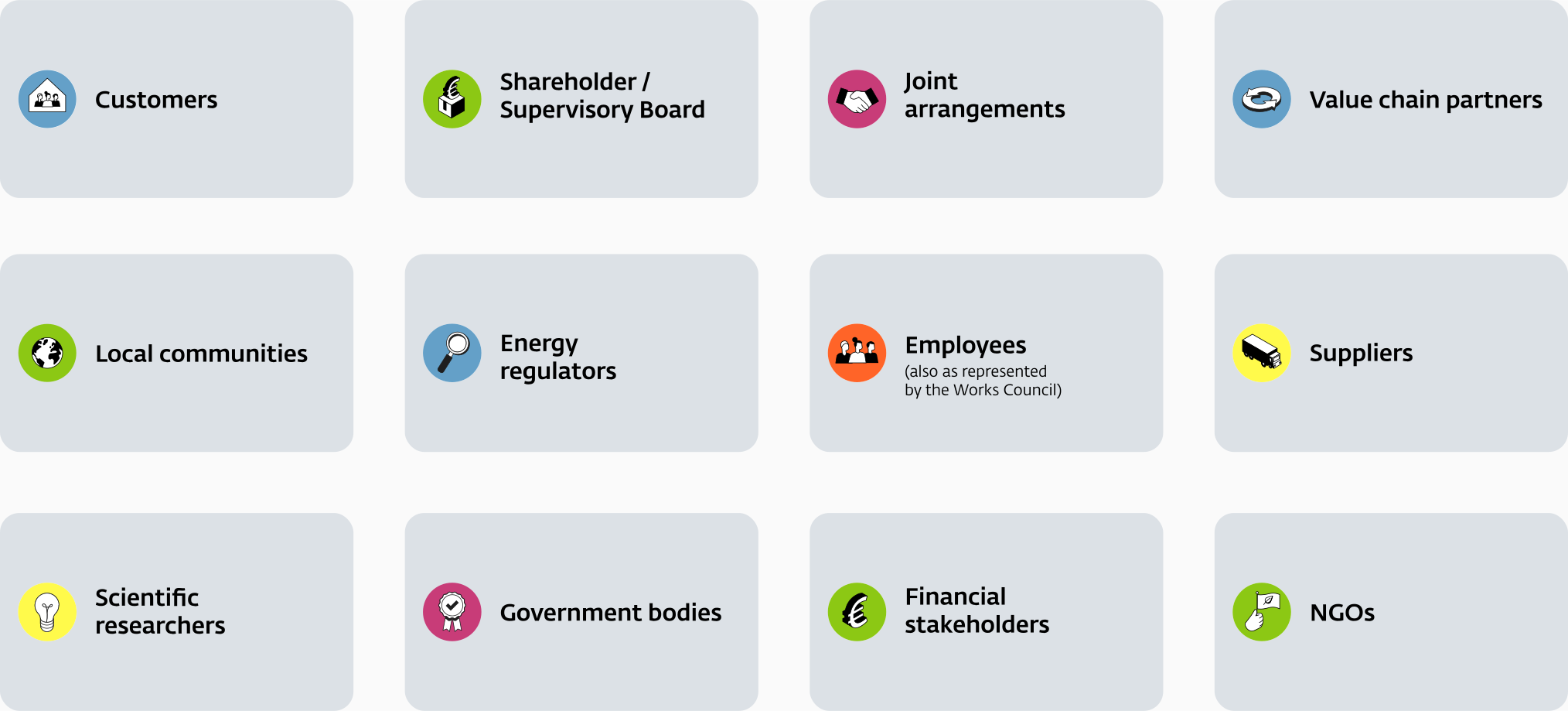
Certain types of stakeholders are involved to a greater or lesser extent depending on the specific activities, initiatives or projects. When devising our strategy, the focus may be on our dialogue with our customers, or with representatives of the Dutch government, for example, or perhaps with the shareholder/Supervisory Board or the Works Council. In the physical implementation of our projects, we attach great value to the dialogue with local communities and those living and working close to the construction sites. And when it comes to the operation of our existing infrastructure, the energy regulators play an important role.
In the performance of their duties, the Executive Board and the Supervisory Board must weigh up all stakeholder interests, basing their ultimate decisions on creating sustainable value in the long term and the continuity of our company. Our stakeholders can trust that their interests are always being carefully considered; we see this as the basis of good business practices and a prerequisite for ongoing cooperation and collaboration with our stakeholders.