
Energy transition
Energy transition
By burning fossil fuels like coal, oil and gas, humans produce large amounts of greenhouse gases that contribute to global warming. The consequences of this warming have an adverse impact on many different aspects of our lives. Switching to energy from renewable sources and storing captured CO2 will enable us to abate global warming. The EU has set itself the target of reducing greenhouse gas emissions by 55% by 2030 compared to the 1990 emission levels as a step towards achieving climate neutrality by 2050.
Impacts, risks and opportunities
We want to use our infrastructure and knowledge to enable the users of our networks to make the switch to zero-emission energy. Based on the double materiality assessment, this presents the following impacts, risks and opportunities for Gasunie.
| No. | ESRS | Material topic - ESRS | IRO |
|---|---|---|---|
| 11 | ES | Energy transition | Actual positive impact: Providing access to net-zero GHG emissions energy and/or CCS enables downstream parties to reduce greenhouse gas emissions and therefore slow down and reverse global warming. |
| 12 | ES | Energy transition | Risk: Providing access to clean energy and/or CCS will in time take away the need for natural gas import, storage and transport services, which is currently the biggest source of income for Gasunie. Making this new source of income (clean energy/CCS) as profitable as natural gas will be very hard for Gasunie. |
| 13 | ES | Energy transition | Risk: Gasunie's future earning potential due to the decline in demand for energy transport services, caused by the departure of energy-intensive industries (deindustrialisation) connected to the Gasunie network. |
| 14 | ES | Energy transition | Opportunity: The societal transition towards net-zero GHG energy creates the need for additional transport infrastructure, storage and terminals for biomethane, hydrogen, heat, CO2/CCS, both onshore and offshore, and therefore creates new market/financial opportunities for Gasunie. |
| 15 | ES | Energy transition | Risk: Gasunie will make significant investments in renewable energy infrastructure projects to achieve its objectives in the energy transition. The long lead times or other obstructions in these complex projects can cause budget overruns, which can lead to a deterioration of the company’s overall solvency. This could result in discussions with the shareholder, cutbacks, postponement or putting energy transition projects on hold. |
| 16 | ES | Energy transition | Risk: There is a risk that Gasunie’s pace in developing and implementing new energy projects—such as hydrogen infrastructure or renewable gas solutions—may not align with evolving societal expectations. The organisation could be perceived as moving too slowly. Conversely, moving too quickly without sufficient societal support or understanding may lead to resistance. This misalignment could jeopardise Gasunie’s societal licence to operate and may seriously erode stakeholder trust and could mean we ultimately construct the wrong infrastructure or burden society with high costs. |
Policy
Gasunie is in a good position to drive the energy transition. We expect sustainable gases, alongside electricity, to be essential for the future of our society. By giving sustainable gases, heat and CO2 storage a full role in the energy transition, the transition will be less expensive and run more smoothly. We anticipate that, by 2050, 40% to 60% of society’s energy mix, i.e. the final level of end consumption, will consist of sustainable molecules.
This is why we are building a broad portfolio of projects for hydrogen and captured CO2 transport and storage, alongside projects for heat transport and biomethane feed-in. The first projects are currently under construction. We regularly adjust our investment portfolio to align with market supply and demand, and to lead times for the permitting process.
At some point during the coming decades, the energy transition will change the need for natural gas imports, storage and transport, which are Gasunie’s current sources of income.
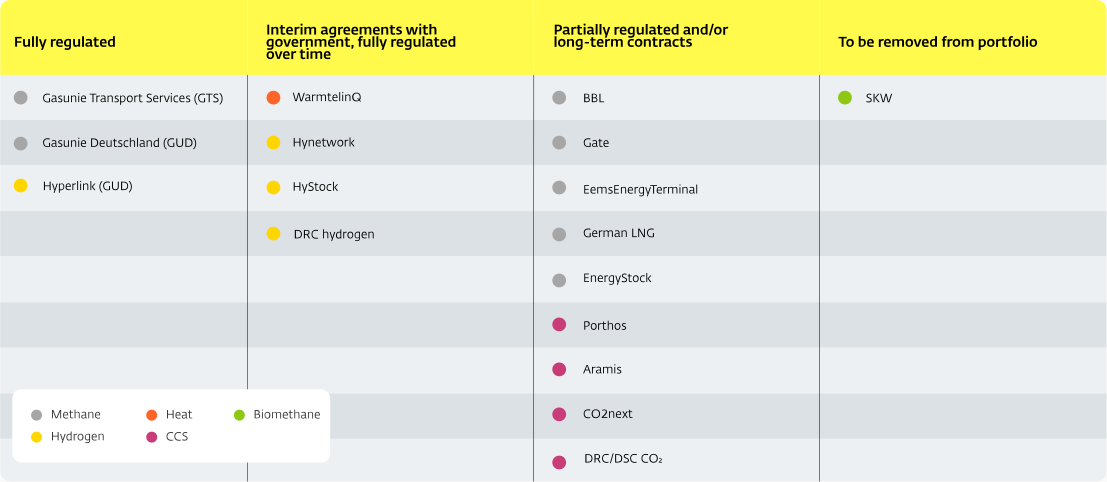
We expect a significant section of the new energy transport systems we are building to be subject to some form of regulation, either immediately or after some time. This is something we endorse because it provides certain assurances for all market parties and is likely to further accelerate the energy transition. That being said, our goal is for the new systems to be sustainable and profitable, whether in a regulated or unregulated environment, and to be able to make a significant contribution to the Dutch economy and the climate in all cases. We are reducing the operational risk posed by infrastructure that does not fall under (tariff) regulation by endeavouring to conclude long-term contracts.
Action plans
CO2 (ST/MT/LT)
Gasunie supports industry in going sustainable through CO2 transport and storage. For hard-to-abate industries that simply cannot switch to clean energy overnight, CO2 transport and storage offers a way to still cut carbon emissions. Without CO2 storage, industries cannot fully decarbonise, putting the future of industry in the Netherlands and north-western Europe under pressure.
CO2 storage marries sustainability to affordability, enabling companies to maintain their operations in the Netherlands and gradually transition to clean energy. A well-developed CO2 network will allow us to preserve jobs in industry, as well as knowledge and innovation.
Gasunie channels its 60 years of energy infrastructure experience into new solutions for CO2 transport and storage. Under the North Sea, there are empty gas fields that can be safely used for CO2 storage. We will connect onshore industries to this available offshore storage space, including for CO2 from neighbouring countries. Projects such as Porthos show how this connection works in practice and provide clarity and certainty for companies to continue investing.
CO2 storage will remain important in the long term. New technologies can even capture CO2 directly from the air or seawater. In this way, Gasunie links solutions for today with the sustainable industry of tomorrow.
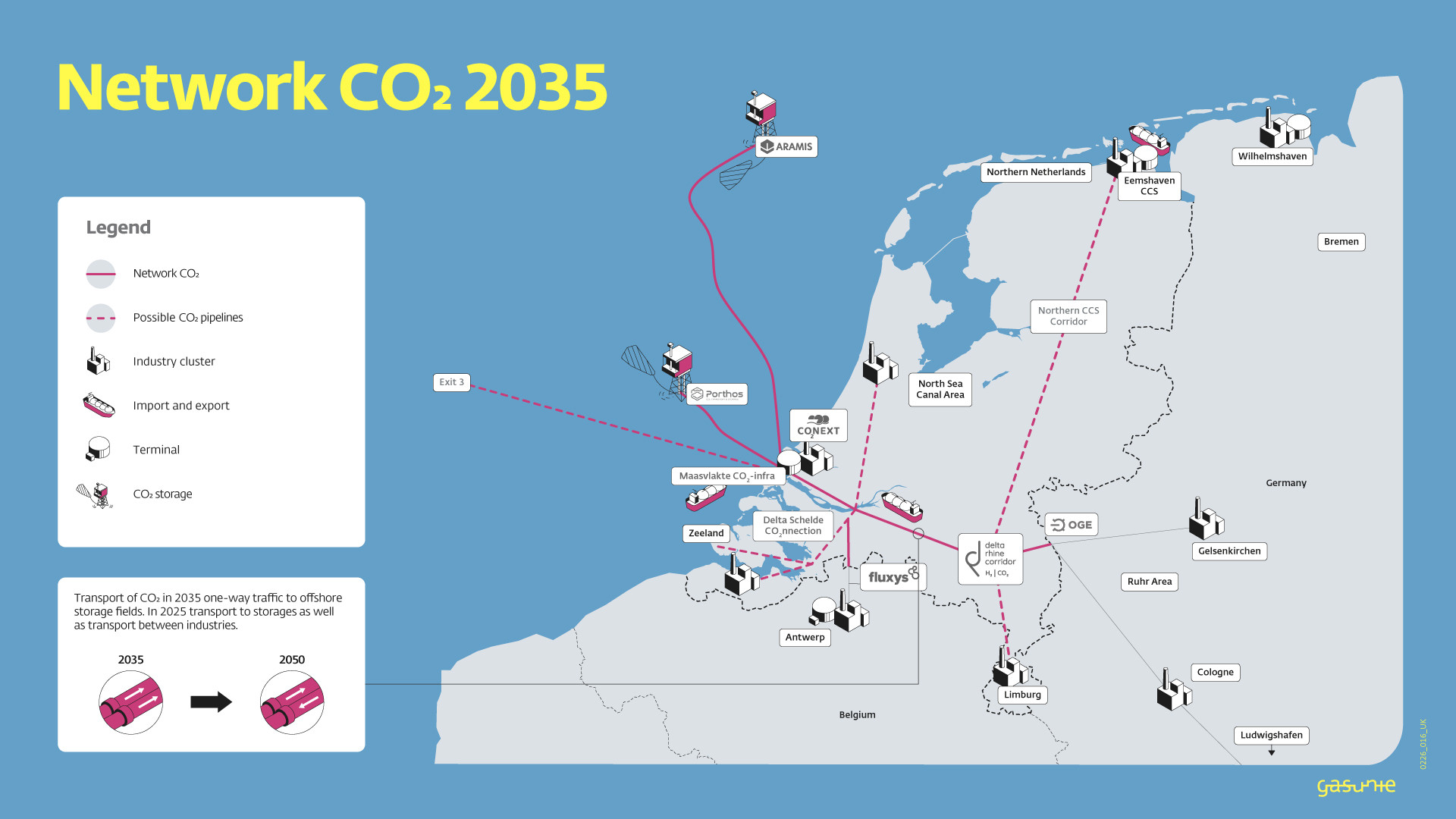
Together with partners, Gasunie is working on several specific, major projects to transport captured CO2 to storage locations: Porthos, Aramis, CO2next, Delta Rhine Corridor (DRC) and Delta Schelde CO2nnection (DSC). All have a clear link with the Rotterdam port area, and all play a major role in achieving the Dutch climate targets.
The key to success is reducing the fully integrated costs of CCS across the entire value chain: from capture to transport and storage. More needs to be done; additional innovation is required, and new technologies must be developed to reduce these costs. This is a shared responsibility of both industry and government. Gasunie supports these innovations and encourages further collaboration between industry, technology providers, knowledge institutions, and government.
Our projects
| Project | (Expected) investment decision year | Expected delivery time | Total CO₂-emissiereduction we enable with this by 2030 | Total CO₂-emissiereduction we enable with this by 2035 |
|---|---|---|---|---|
| Porthos | 2023 | ST | 6,1 Mt | 17,7 Mt |
| Aramis | 2027 | MT | ||
| CO₂next | 2027 | MT | ||
| Delta Rhine Corridor west | 2030 | LT | ||
| Delta Schelde CO₂nnection | 2031 | LT |
Porthos
Porthos is an initiative by Gasunie, EBN and the Port of Rotterdam. Porthos will store around 2.5 Mt CO2 per year over a period of 15 years, up to a total of about 37 Mt, ultimately cutting industrial carbon emissions at the Port of Rotterdam by around 10%. Porthos customers Shell, ExxonMobil, Air Liquide and Air Products will feed CO2 into the 30-kilometre open-access pipeline that will soon run through the Rotterdam port area.
The CO2 will be transported via the offshore pipeline to a former gas production platform in the North Sea, located approximately 20 kilometres off the coast. From there the CO2 will be pumped into depleted gas fields located in sealed spaces of porous sandstone more than 3 kilometres under the seabed of the North Sea.
In May, Porthos formally acquired the P18-A gas production platform from TAQA and TAQA began work on converting the platform. In July, the final metres of the offshore pipeline were laid. In May, it was brought ashore under the seawall. We currently expect Porthos to become operational in 2026.
Aramis
Aramis is a similar project to Porthos, but its annual processing capacity will be 22 Mt, making Aramis one of the largest CCS projects in north-western Europe. Aramis can use the space that is still available in the onshore part of the Porthos pipeline, which can transport up to 10 Mt per year.
The Aramis project is a joint venture of TotalEnergies, Shell, EBN and Gasunie. In April 2025, Gasunie and EBN took greater control of the further development of the Aramis infrastructure. TotalEnergies and Shell will continue to be involved as partners up to when the final investment decision is made, contributing technical knowledge and expertise to help complete the project. After that point, the Aramis infrastructure, i.e. the pipeline and distribution platform, will be wholly owned by Gasunie and EBN. In contrast to the Porthos project, Gasunie will not be a co-owner of the storage facility.
In 2025, one party lodged an appeal with the Dutch Council of State against the Aramis project decision and several Aramis implementation decisions, which is expected to push the final investment decision date back from 2026 to 2027. This can only be prevented with a swift ruling by the Council of State in the first half of 2026. Further delays will mean that Aramis can no longer help the Netherlands meet its national carbon reduction target for the year 2030.
CO2next
The CO2next terminal located at the Port of Rotterdam will soon be able to receive liquid CO2 by ship or train from customers who are not connected to a pipeline. CO2next is set to become a hub accessible to all industries that emit CO2 and want to supply it for permanent storage (CCS) in empty gas fields under the North Sea or, in the more distant future, for reuse elsewhere. CO2next is being developed jointly by Gasunie, Vopak, Shell and TotalEnergies.
DRC
Delta Rhine Corridor (DRC) is an international public-private energy infrastructure project for CO2 and hydrogen transport between the Netherlands and Germany. The corridor and the connections it will facilitate will help make industry in north-western Europe more sustainable and keep companies from moving elsewhere, and it will contribute to strengthening international cooperation and making the energy infrastructure future-proof. DRC West consists of a CO2 pipeline and a hydrogen pipeline running between Rotterdam and Boxtel, while DRC East is a CO2 pipeline between Boxtel and the German border near Venlo.
In 2025, DRC was in the project procedure phase. For the western section of the DRC, documents published in September form the basis for consultation with and participation by stakeholders, including local residents, businesses and civil society organisations. This local knowledge is expected to help us further optimise the project.
DSC
The Delta Schelde CO2nnection (DSC) is a CO2 infrastructure project for the capture of CO2 emitted by industrial clusters in the south-western part of the province of Noord-Brabant in the Netherlands and Antwerp in Belgium. This infrastructure runs from the Belgian border to the Moerdijk area, where it is planned to link up with the Delta Rhine Corridor (DRC).
In 2025, several parties signed a letter of intent for the future use of the DSC and the project procedure was launched. The Delta Schelde CO2nnection has been included as a project in the Dutch multi-year energy and climate infrastructure programme (‘MIEK’). The DSC also has PCI (Project of Common Interest) status. In the spring of 2025, the underlying project procedure coordinated by the Dutch State was launched, and work began on a combined publication of the Notification of Intent and Participation and the draft version of the Memorandum on Scope and Level of Detail in 2026.
The DSC is part of Gasunie’s CO2 network, which has been designed with future connections to other industrial clusters in mind, such as the industrial cluster in the province of Zeeland.
Hydrogen (ST/MT/LT)
Hydrogen is indispensable for a future with clean energy. Renewable energy from wind and solar can be converted into hydrogen, which is easy to store and transport. This allows us to run power stations and industry on hydrogen when the wind isn’t blowing and the sun isn’t shining. Hydrogen also makes our energy system more flexible and reliable.
For large industries and power plants, hydrogen is one of the solutions to reduce CO2 emissions. Gasunie connects these sectors with the energy they need to decarbonise. Hydrogen and other technologies, such as CO2 storage, can help industry transition away from natural gas, thus making it more viable for these companies to continue operating in the Netherlands.
Hydrogen can be safely stored underground, for example in projects like HyStock. A single cavern can hold just as much energy as 2.5 million batteries. Our aim is to connect storage capacity directly with the places where energy is needed, providing security of supply when energy availability is low.
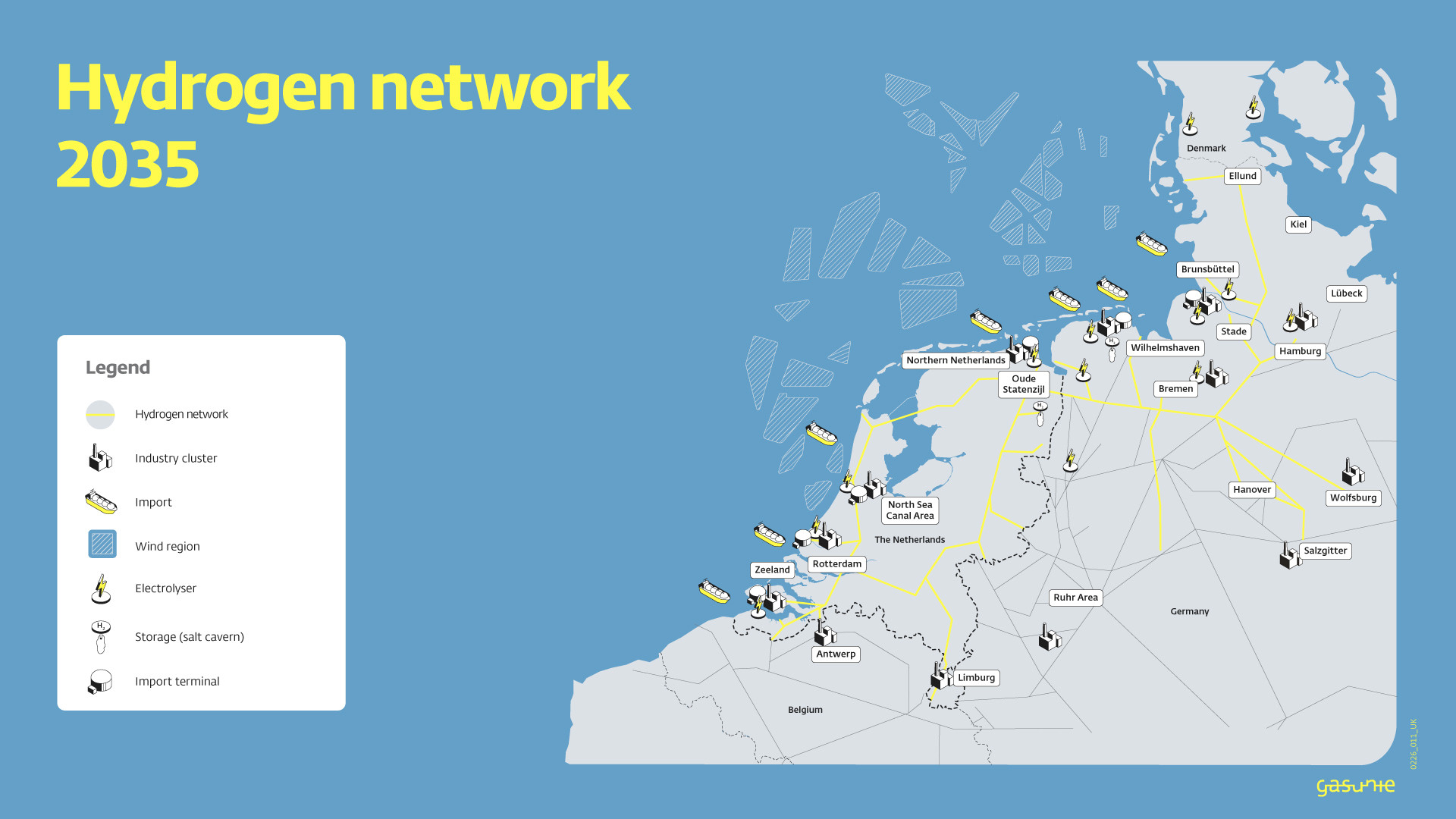
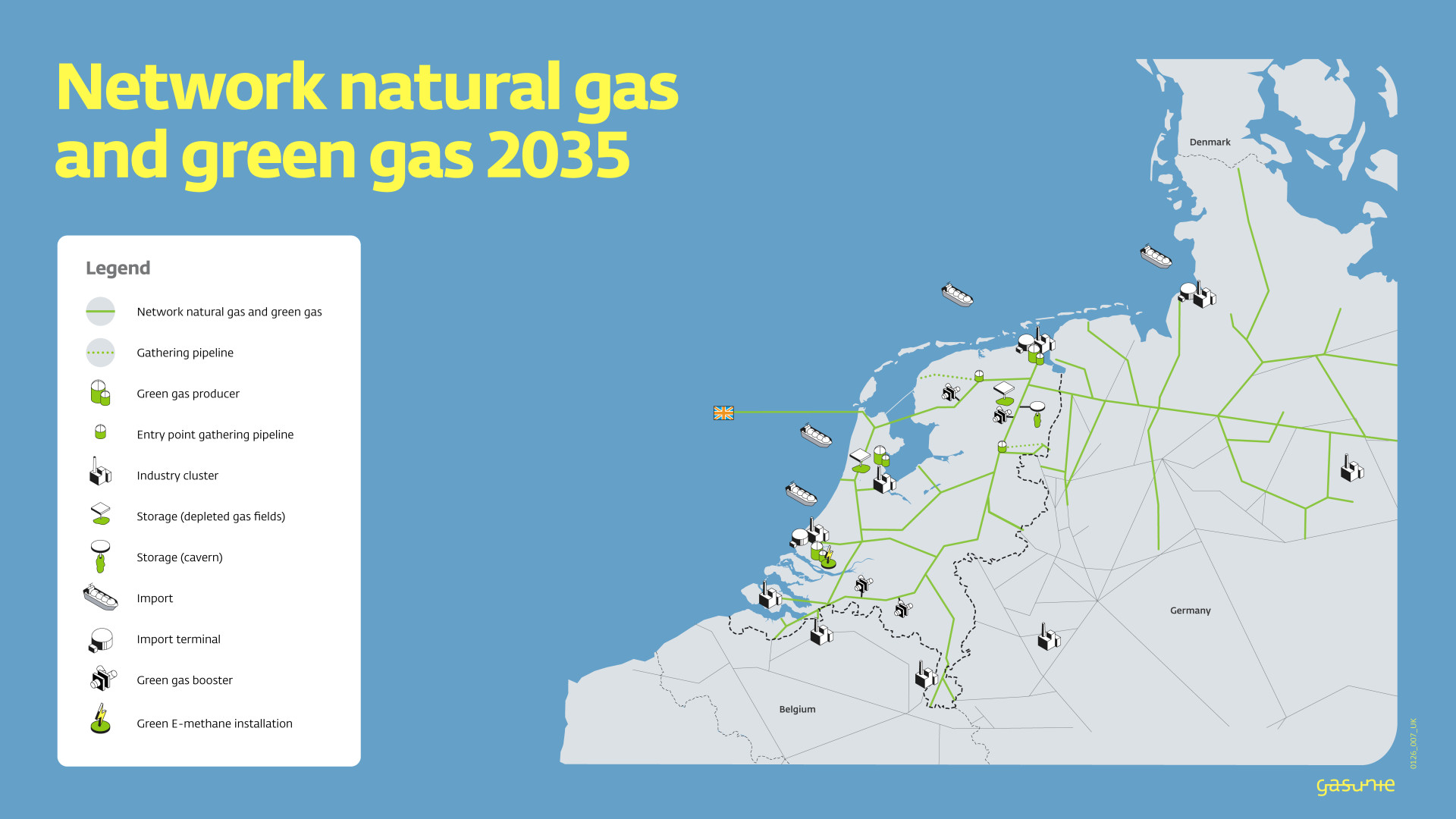
Gasunie has been transporting hydrogen since 2018, with an increasing number of projects forming the foundation for a nationwide network. By 2033 at the latest, the five major industrial clusters in the Netherlands and industry abroad will be interconnected via this network. Most of the infrastructure will consist of repurposed natural gas pipelines, as we combine experience, existing networks and future-proof energy in a smart solution.
There are different types of hydrogen: grey, green and blue. Gasunie is working towards a future with green hydrogen, which is the most sustainable type. Green hydrogen is produced using electricity from renewable sources, such as wind and solar power. Since not yet enough green hydrogen production capacity is currently available, we are using blue hydrogen for the time being. Blue hydrogen is produced from natural gas, whereby the CO2 emitted by this process is captured and stored. This is how natural gas provides the opportunity to develop the hydrogen network for a future with green hydrogen.
Our projects
| Project | (Expected) investment decision year | Expected delivery time | Total CO₂-emissiereduction we enable with this by 2030 | Total CO₂-emissiereduction we enable with this by 2035 |
|---|---|---|---|---|
| Hydrogen networknetwerk Rotterdam | 2023 | ST | 0,5 Mt | 1,9 Mt |
| Hydrogen network Northern region of the Netherlands, including connections to HyStock and Germany | 2026-2027 | MT | ||
| Hydrogen network Northwest of the Netherlands | 2027 | MT | ||
| HyStock (1st cavern) | 2027 | MT | ||
| Hydrogen networknetwerk South-Western Netherlands, including connections to Belgium | 2027-2028 | MT | ||
| Hydrogen network Eastern Netherlands | 2028-2029 | LT | ||
| DRC West | 2028-2029 | LT | ||
| Hydrogen networknetwerk Western Netherlands | 2027-2028 | LT | ||
| Hydrogen networknetwerk Limburg | 2027-2029 | LT |
| Project | (Expected) investment decision year | Expected delivery time | Total CO₂-emissiereduction we enable with this by 2030 | Total CO₂-emissiereduction we enable with this by 2035 |
|---|---|---|---|---|
| Hyperlink-1 | 2024 | MT | 1,3 Mt | 3,0 Mt |
| Hyperlink-2 | 2026 | MT | ||
| Hyperlink-3 | 2027 | MT | ||
| Hyperlink-4 (Nord) | 2026 | MT | ||
| Hyperlink-4 (Süd) | 2031 | LT | ||
| Hyperlink-5 | 2029 | LT |
The Dutch network
The various parts of the national hydrogen network reached different stages of development in 2025. The 32-kilometre Rotterdam Hydrogen Network is the furthest along and is expected to be completed in the first half of 2026.
After the Rotterdam section, the sections in the northern Netherlands (Groningen Hydrogen Network, Drenthe Overijssel Hydrogen Network and North Sea Canal Area Hydrogen Network) were at the most advanced stage of development in 2025, followed by the South-Western Netherlands Hydrogen Network (province of Zeeland and the western part of Noord-Brabant) and the Eastern Netherlands Hydrogen Network (provinces of Overijssel/Gelderland/Noord-Brabant). The eastern part of the national hydrogen network will be fully made up of repurposed natural gas pipelines.
These will be followed by the Western Netherlands Hydrogen Network (province of Zuid-Holland) and DRC West. DRC West is the western section of the Delta Rhine Corridor, consisting of hydrogen and CO2 pipelines running from Rotterdam to Boxtel. The Limburg Hydrogen Network and the IJsselmeer route are the final projects in the roll-out plan. For full details of the roll-out plan, see the Hynetwork website.
In December, the Netherlands Court of Audit published a report on the national hydrogen network. According to the report, the Minister for Climate Policy and Green Growth has demonstrated that hydrogen infrastructure is both useful and necessary for the Netherlands in order to reach climate neutrality by 2050. The report confirms what we have also seen in practice: that projects of this size and with this level of innovation are new, complex and challenging. We are currently in constructive talks with our shareholder, the Ministry of Climate Policy and Green Growth, the regulatory authority and the market on the financing for the costs of the network over the initial years after completion, to ensure stable and affordable transport tariffs.
The German network
Together with other German gas TSOs, Gasunie is building the national core network for hydrogen, known as the ‘Kernnetz’ in German, which will span around 9,000 kilometres. The parts of this transmission network in north-western Germany, totalling roughly 1,000 kilometres, are being built by Gasunie Deutschland, under the name Hyperlink.
Hyperlink will enable hydrogen transport from the Dutch and Danish borders to demand centres in Germany, such as the Hamburg region, the Bremen region, the Salzgitter steelworks and onwards to the important Leuna industrial cluster. Roughly 70% of Hyperlink will be made up of repurposed existing pipelines and 30% will be newly laid pipelines.
In 2025, we focused mainly on construction (repurposing) of the Hyperlink-1 section between the Dutch-German border and Hamburg. After that, there will be further repurposing for Hyperlink-2 and new pipelines laid to deliver hydrogen to the Salzgitter steel plant from Achim and create a connection to the Leuna industrial cluster.
In 2025, regulatory authority BNetzA published or announced several regulatory decisions on the future regulation of hydrogen transport in Germany. GUD is taking part in the associated consultation processes, along with other German TSOs.
Market demand is currently not yet developing to the extent that was initially expected when the Kernnetz was approved. The next version of the ‘Netzentwicklungsplan’ (Grid Development Plan) for natural gas and hydrogen, which the joint network operators are currently working on, will factor in these market developments. The implications of several other scenarios will also be assessed.
Imports
Gasunie is working on terminals for hydrogen carrier imports, including the ACE Terminal project in Rotterdam, as demand for hydrogen in the Netherlands and north-western Europe will exceed the expected local production capacity. Additionally, imports will help keep our energy supply affordable and secure. We are looking at the ports of Rotterdam and Eemshaven, as well as other locations, as entry points for imports. In the future, these and other seaports in the Netherlands and Germany will be connected to the industrial clusters, hydrogen storage facilities and the market in north-western Europe by the hydrogen network, making them ideally suited as entry points for hydrogen carrier imports.
Setting up international hydrogen chains is complex and requires considerable public/private cooperation. In view of this, Gasunie and other state-owned companies, in cooperation with the Ministry of Climate Policy and Green Growth and the Ministry of Foreign Affairs, have been investigating possibilities for fruitful collaborations with parties and governments outside the Netherlands. We are aiming to participate in several international partnerships over the coming years.
Storage
Large-scale storage of hydrogen is crucial for a well-functioning hydrogen market. This was again confirmed in 2025 by the Ministry of Climate Policy and Green Growth in its National Agenda for Underground Hydrogen Storage. In the Netherlands, Gasunie is working on an underground hydrogen storage facility in Zuidwending as part of the HyStock project. The Minister of Climate Policy and Green Growth published the final Preferred Alternative for this in August 2025.
In Etzel (Germany), Gasunie and Storag Etzel are jointly working on the H2CAST pilot project, testing hydrogen storage in two small existing caverns. Meanwhile, construction of the aboveground installation is in full swing and the caverns will be filled with 90 tonnes of hydrogen. In 2026, we started running the test programme for this installation.
In the coming years, we will continue to work on hydrogen storage at the Zuidwending underground storage facility, which we will do in close contact with local communities, and we will investigate alternatives for storage in other regions in the Netherlands and in Germany.
Offshore
In 2025, the Dutch government lowered the target for offshore wind power production capacity from 50 to 30-40 GW by 2040 in its North Sea Wind Energy Infrastructure Plan. This affects both the timing and scale of offshore hydrogen production, significantly slowing Gasunie’s preparations for development of an offshore hydrogen network.
In order to hit the climate targets, offshore hydrogen will still feature in the energy transition. As far as we are concerned, the importance of system integration remains undiminished. While system integration begins on the shore, increasing energy generation offshore will also make system integration increasingly important there. Gasunie has teamed up with other TSOs from countries around the North Sea in the HyNos initiative in order to create an international offshore hydrogen network in the future.
The North Sea’s ecological resilience continues to be a key consideration. Where appropriate, we will be reusing existing infrastructure. We will ensure that all knowledge acquired on nature-inclusive infrastructure remains accessible and is used in future developments. We develop knowledge through studies and system integration, which is how we ensure that the required offshore infrastructure can be built in time in the future, at the same pace as the government and wind power developers intend to start producing hydrogen at sea.
Heat (MT)
In specific areas, and densely populated urban districts in particular, heat networks offer benefits as an affordable decarbonisation option.
Heat networks deliver a win-win situation, as they relieve the power grid and utilise waste heat from industry and other sources that would otherwise be discharged. Our heat infrastructure will also be accessible to operators of geothermal energy sources.
As a state-owned, independent party, Gasunie unifies interests, turns plans into actionable solutions and provides reliable heat infrastructure that everyone can build on.
Our projects
| Project | (Expected) investment decision year | Expected delivery time | Total CO₂-emissiereduction we enable with this by 2030 | Total CO₂-emissiereduction we enable with this by 2035 |
|---|---|---|---|---|
| WarmtelinQ section Vlaardingen-The Hague | 2021 | MT | 0,1 Mt | 0,2 Mt |
| WarmtelinQ section Vondelingenplaat-Vlaardingen | 2024 | MT | ||
| WarmtelinQ section Rijswijk-Leiden | 2023 | MT |
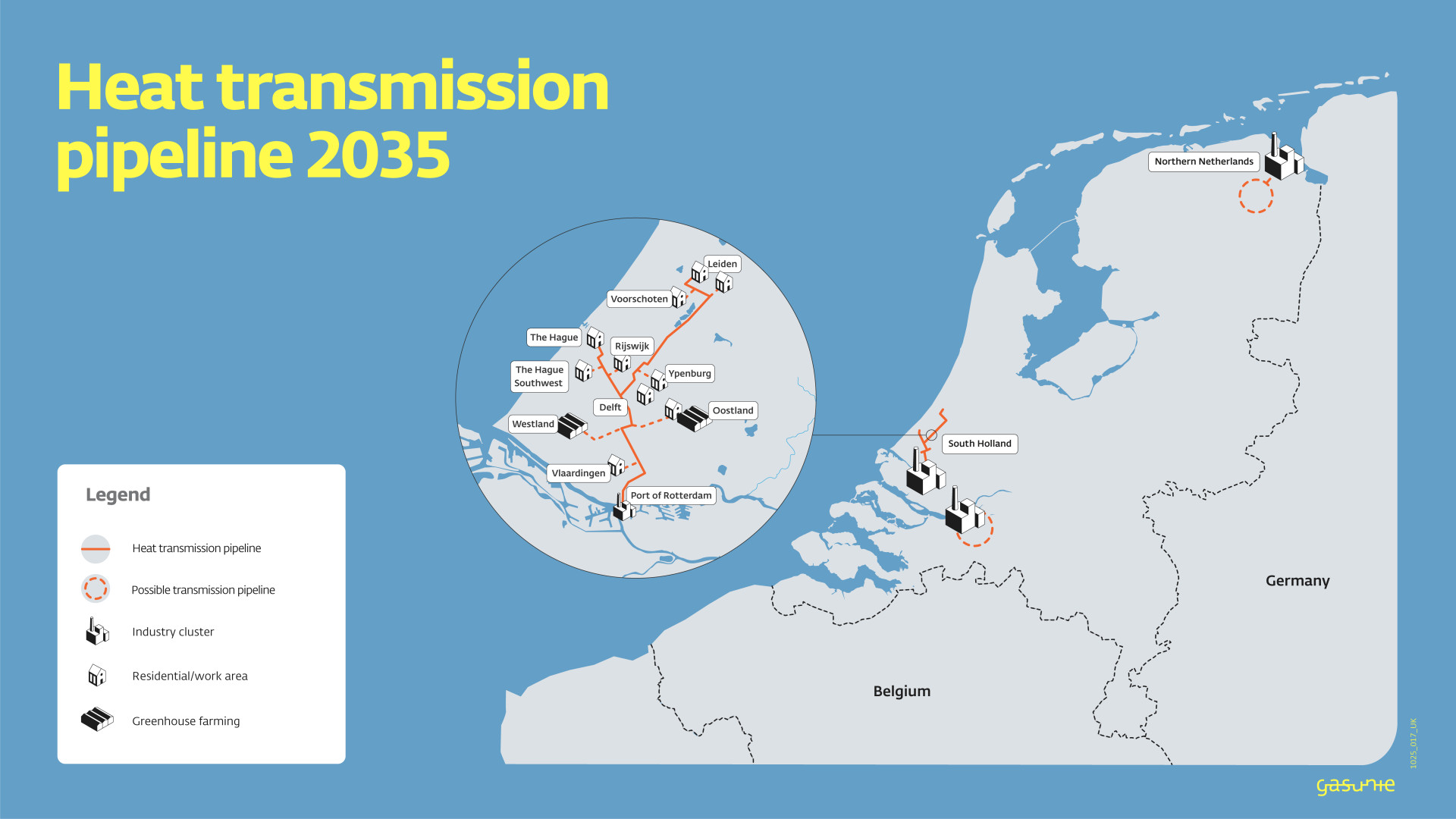
In 2025, Gasunie performed an extensive review of the scope, timetable and budget of the WarmtelinQ project. These three aspects of the project had come under strain due to high inflation, market conditions and other factors. We looked into what is needed to still bring the project to full completion and are in talks about this with the Ministry of Finance.
the end of 2025, virtually all pipeline sections of the Vlaardingen-The Hague stretch had been laid, and the remaining work is expected to be done in 2026. In the autumn of 2025, contractor Hanab completed the pumping station in Delft and transferred it to WarmtelinQ. Preparatory works for the Rijswijk-Leiden section are also underway, In Leiden, WarmtelinQ and Vattenfall are working together on the construction of a peak and backup plant. This plant will provide additional capacity during periods of peak demand, back-up capacity during outages or maintenance, and heat storage in a large 35-metre-tall tank.
With the waste heat WarmtelinQ will soon be transporting from the Port of Rotterdam to The Hague and Leiden, 120,000 homes can be heated, saving 123 million cubic metres of natural gas annually. To put it into perspective, the savings achieved through WarmtelinQ are comparable to those of 1,100 football pitches (740 hectares) of solar panels or 100 of the most technologically advanced onshore wind turbines.
Biomethane (MT)
Switching to sustainable energy is no small task. Gasunie bridges today and tomorrow by ensuring that the Netherlands has sufficient energy and the energy transition remains achievable. Biomethane can help make this transition easier in the short term.
Biomethane is produced from residual materials, such as unsold food from supermarkets or agricultural waste. Gasunie harnesses this sustainable energy for use in homes and transport, including as fuel for lorries or industrial processes.
Biomethane is readily available now, we do not have to wait five or ten years for it. Gasunie can distribute it immediately through its existing network, delivering domestically produced energy to households and industry, reducing Dutch dependence on foreign energy and making it easier for companies to decarbonise.
Biomethane is easy to distribute and store using the existing gas network. This will relieve pressure on the already congested power grid and integrate different energy sources into a single, reliable system, ensuring energy availability even when the sun isn’t shining or the wind isn’t blowing.
Biomethane empowers everyone to join the energy transition. Gasunie makes clean energy accessible to otherwise hard-to-abate homes and businesses, such as historic buildings or homes where a heat pump is not an option. Biomethane can make sustainable heating affordable and reliable across the Netherlands.
Dutch Climate Agreement
Under the Dutch Climate Agreement, the Netherlands has set itself the target of producing 2 bcm of biomethane annually from 2030; this is currently around 0.22 bcm. Gasunie sees many opportunities for market parties to scale up the production of biomethane and wants to help this along by facilitating the feed-in of biomethane into the Gasunie network. This is where the biomethane boosters come in, as they can up the pressure of the biomethane in the regional network to the level required for the national grid.
Gasunie is also helping to develop the gasification technology needed to produce larger volumes of biomethane and is active in two projects for this purpose: EemsGas and SKW Alkmaar. Gasunie also supports the sector by certifying biomethane, and by actively participating in the Dutch Biomethane Platform and the European Biogas Association.
Blending obligation
From 2027, energy suppliers may become subject to a blending obligation for biomethane. We welcome this way of boosting demand because we believe it is a key step towards creating a sustainable, reliable and affordable energy system.
Network adjustments
In 2025, GTS built a connection for a major biomethane producer in Delfzijl. Extensive work has also gone into transportable biomethane boosters. These boosters are used to move seasonal biomethane surpluses in the distribution network to the regional GTS distribution network (RDN). The boosters will be installed at the Tilburg and Mill sites in 2026. The RDN in Ossendrecht and Axel will also be connected in 2026 to provide a feed-off route from the Zeelandic-Flanders region to the province of Noord-Brabant.
Our projects
| Project | (Expected) investment decision year | Expected delivery time | Total CO₂-emissiereduction we enable with this by 2030 | Total CO₂-emissiereduction we enable with this by 2035 |
|---|---|---|---|---|
| Collector pipeline Emmen-Ommen | 2021 | ST | 1.1 Mt | 2.6 Mt |
| Collector pipeline Zuidwal | 2026 | MT | ||
| Eemsgas | TBD | TBD | ||
| SKW Alkmaar | 2016 | TBD |
Gathering pipelines
Gasunie is working on two projects to repurpose a 60-kilometre natural gas pipeline as a biomethane gathering pipeline. Distribution network operators will be able to use these pipelines to transport biomethane at a pressure of under 8 bar. At the end of the gathering pipeline, Gasunie will install a central compressor to pump gas directly into the GTS high-pressure gas network (HPGG). The gathering pipeline between Emmen and Ommen will be put into operation in 2026 (initially planned for 2025). Distribution companies Rendo (Coevorden and Hoogeveen region), Coteq (Hardenberg region) and Enexis (Emmen) will feed biomethane off to this pipeline. Scheduled to be completed in early 2028, the Zuidwal gathering pipeline between Harlingen and Kootsterstille will be used by Liander (Harlingen and Leeuwarden region) and Stedin (Garijp region).
Eemsgas
In 2025, EemsGas Asset Company (a joint venture of Gasunie New Energy and Perpetual Next) continued work on the development of EemsGas, which will be a commercial gasification plant in Delfzijl. In late 2025, this project was awarded a € 30 million DEI+ grant, which Gasunie takes as confirmation that the project has potential on both a technical and social level, and will help Gasunie fulfil the blending obligation for biomethane that is expected to take effect as of 2027. EemsGas expects to be able to initiate the FEED study in 2026, which takes us yet another step closer to the point where we will have to make the investment decision. EemsGas aims to supply biomethane to the local natural gas network and steam to the local steam network.
Alkmaar SCW gasification plant
In 2025, we continued work to make the SCW gasification plant in Alkmaar more robust by making some changes to the design and subsequently testing the new design. This saw us produce approximately 17,914 m3 of syngas. Further testing will follow in 2026, and we once again expect to be able to produce additional biomethane using the technology of supercritical water gasification.
Gasunie Deutschland
In 2025, Gasunie Deutschland received multiple requests from biomethane producers to connect their plants to the high-pressure grid. As grants for power generation from biogas are being phased out, producers have started looking for alternative outlets. Gasunie Deutschland is under a statutory obligation to connect biomethane plants, subject only to technical feasibility. We expect the number of new requests for network connections to start dropping due to proposed amendments to network access legislation.
One of the new requirements is that a deoxygenation plant must be added when a biogas connection is near an underground gas storage facility, which poses certain design challenges. On top of that, the total costs of biogas connections have soared compared to previous projects, partly due to the additional investment in deoxygenation plants. All costs incurred to build biogas connections will be passed on to the market.
In Germany, there were a total of five biogas plants with a direct connection to our high-pressure network by the end of 2025. Aside from that, we have four biogas injection projects ongoing, with a further three connection requests submitted by the end of 2025.
Resources
According to our baseline scenario, the value of Gasunie’s total net investment agenda from 2026 through to 2030 will come in at approximately € 10.5 billion. Of this amount, about three quarters will go towards energy transition projects. We are currently in the process of mapping out our expected capital expenditures over the years beyond 2030.
Our forecasts
The Netherlands wants to have net-zero carbon emissions by 2050. A major contribution to this will come from the users of Gasunie’s networks by making use of the new infrastructure Gasunie will be installing this decade for the transport and storage of hydrogen, heat and captured CO2, and thanks to the ever-increasing amount of biomethane we are transporting through our existing energy networks.
Each year since 2021, we have been calculating the extent of this contribution in megatonnes (Mt) of carbon saved per year. In this regard, we are not setting firm targets that we hold ourselves accountable for; the energy transition is too complex a process for that, with too many factors that are beyond our control. These are forecasts, i.e. our most up-to-date estimates of what we will achieve given the current state of permitting procedures, the availability of people and materials, and market demand.
Since 2021, we have been using 2030 as the time horizon for our calculations. This has allowed us to factor in the energy transition projects that we have specifically had in mind ever since we adopted our transition strategy in 2020, i.e. our transformation from a gas transmission company to an energy infrastructure company.
In the 2025 annual report, our forecasts go up to both 2030 and 2035. We are not (yet) looking ahead to 2040: the results would then become too uncertain.
We compare the megatonnes of reduced emissions we could be facilitating in the Netherlands up to 2030 and 2035 with the total emission reduction the Netherlands will have to achieve on average per year to reach net-zero emissions in 2050. This is known as the ‘national transition pathway’. We also compare our contribution with the contribution of other sectors, which we get from the latest edition of the Climate and Energy Outlook published by the Netherlands Environmental Assessment Agency PBL in September every year.
Development of our forecasts
For the years through to 2030, we will not be able to reduce emissions by the amount we thought we could a year ago. We now think that our energy transition projects will enable users to cut 7.8 Mt of carbon emissions by 2030, compared to our estimate of 16.4 Mt by 2030 in last year’s annual report.
While last year’s drop to 16.4 Mt by 2030 was caused primarily by delays in the construction of the Dutch hydrogen network, the downward revision to 7.8 Mt by 2030 is mainly because of the delays we anticipate in our Aramis CCS project.
The hydrogen market will be slower to get going than we initially assumed. We now expect our Dutch hydrogen projects to be able to facilitate an emission reduction of 1.9 Mt by 2035. Last year, the expectation was that we would be able to facilitate a reduction of 2.3 Mt by as early as 2030.
Since many of the energy transition projects we are currently working on will reach completion between 2030 and 2035, we expect a facilitated emission reduction of 22.3 Mt by 2035 to be feasible. By way of comparison: total carbon emissions in the Netherlands were 144 Mt in 2024.3
3Statistics Netherlands (CBS), GHG emissions calculated according to IPCC guidelines.
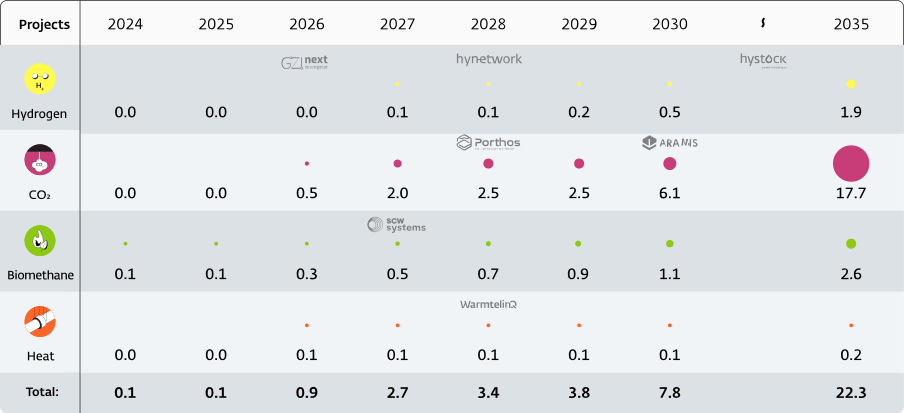
We also enable industries to cut their carbon emissions by facilitating their switch from coal to natural gas, but we have not included this in our Transition pathway contribution. See also our Transition pathway notes elsewhere in this annual report.
Market demand in the German core hydrogen network (‘Kernnetz’) is currently not yet developing to the extent that was initially expected when the project was approved. We now expect Hyperlink, i.e. our share in Kernnetz, to be able to facilitate a reduction of 1.3 Mt by 2030 (forecast from last year’s annual report: 4.4 Mt by 2030). We anticipate a further reduction of 3.0 Mt by 2035. These reductions contribute to the German national transition pathway.

The Netherlands has a statutory emission reduction target of 55% by 2030 (compared to 1990 emission levels). With the policy the current Dutch government is pursuing, there is a 95% likelihood that our country will not meet this reduction target. This was revealed in the 2025 edition of the Netherlands Environmental Assessment Agency’s annual Climate and Energy Outlook. That said, Gasunie’s efforts do help to close a significant part of the gap between the actual emission reduction and society’s targeted emission reduction.
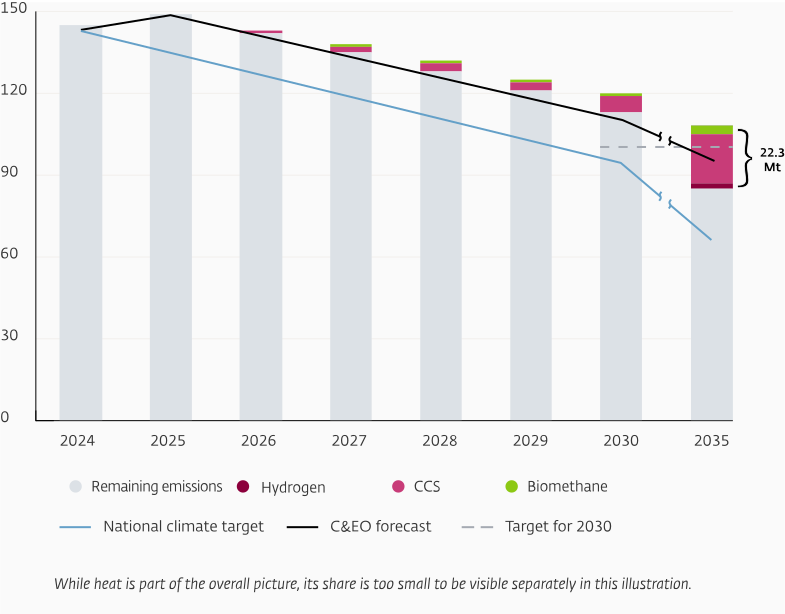
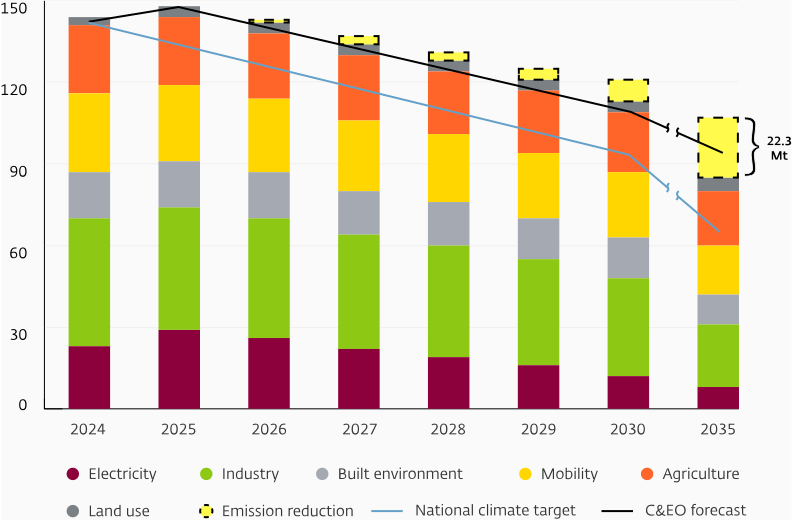
What does this all mean for the 2035-2050 period? We’ve illustrated this in the chart below. The effect of our investments up to the end of 2035 continues to be evident when we extend the horizon to 2050, as shown in the illustration below.
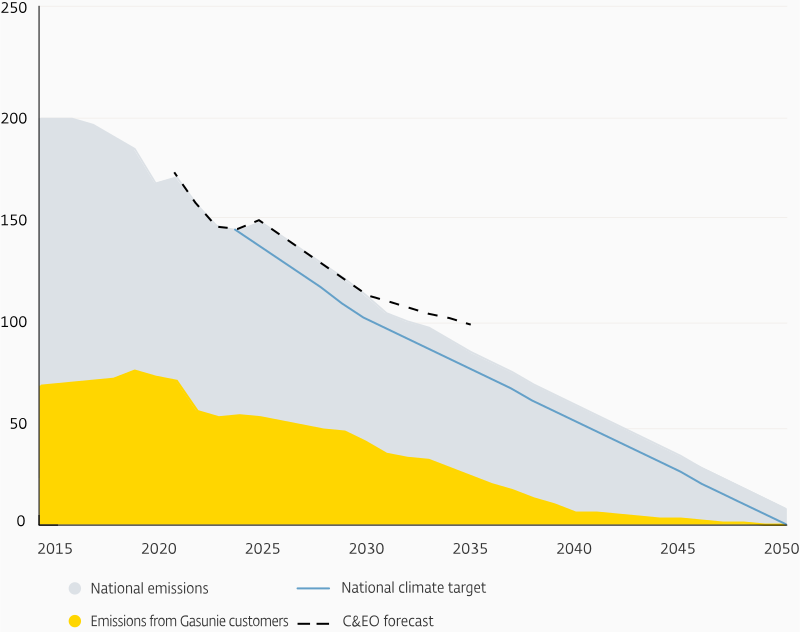
Gasunie will still have a big job ahead of it after 2035. The hydrogen system in particular will need to be expanded, and we also foresee further growth in biomethane and follow-up investments in CO2 transport. An explanation of the tables and charts above and the figures included in these is included as an appendix to this annual report. We are, for now, only considering the effects of our investments between 2020 and 2035. A new series of Gasunie investments for the period from 2035 to 2050 could lead to a steeper decline along the Dutch transition pathway.
Financial impact
Our balance sheet total will increase on the back of our investments. We are confident we will be able to fund most of these investments with borrowed capital. Our preference is to issue bonds (green or otherwise); however, we are also looking at opportunities for project financing and other forms of financing, such as hybrid bond loans and loans from the EIB. Cash flow from our existing activities is another source of financing, and grants (national and European) are a third source.
We provide more details on the energy transition, our green bonds, our sustainability-linked bonds, measurement of our current assets and measurement of other provisions in note 1 ‘Significant matters and events’, note 17 ‘Interest-bearing loans’ and note 22 ‘Other provisions’ to our financial statements. We also describe the assumptions and estimates we use in this regard.
Taxonomy
Gasunie tests annually whether its business activities qualify as climate-related or environment-related Taxonomy-eligible economic activities under the EU Taxonomy. Like in previous years, we concluded that Gasunie’s business activities qualify as climate-related or environment-related economic activities.
| CAPEX | OPEX | Revenue | ||||
|---|---|---|---|---|---|---|
| In millions of euros | % of the total | In millions of euros | % of the total | In millions of euros | % of the total | |
| Taxonomy eligible activities | ||||||
| 4.12 Storage of hydrogen | 18 | 2% | 5 | 1% | - | 0% |
| 4.14 Transmission and distribution networks for renewable and low carbon gases | 190 | 23% | 40 | 5% | 6 | 0% |
| 4.15 District heating/cooling distribution | 124 | 15% | 5 | 1% | - | 0% |
| 5.11 Transport of CO₂ | 14 | 2% | 17 | 2% | - | 0% |
| Total taxonomy eligible activities | 345 | 41% | 67 | 8% | 6 | 0% |
| Total taxonomy non-eligible activities | 489 | 59% | 807 | 92% | 1,545 | 100% |
| Total | 834 | 100% | 875 | 100% | 1,551 | 100% |
Our Taxonomy-eligible activities concern our hydrogen projects (activities 4.12 and 4.14), our heat projects (activity 4.15), our emission reduction projects (activity 4.14), our projects relating to biomethane (activity 4.14) and our CCS projects (activity 5.11).
In addition to the CAPEX in the above table, € 276 million was invested in the Porthos joint venture (activity 5.11) in 2025 (2024: € 138 million). If we were to include our investments in joint ventures when calculating our share of Taxonomy-eligible activities, this CAPEX share would increase from 41% to 49% (2024: from 45% to 53%).
Compared to previous years, the share of Taxonomy-eligible activities in our CAPEX fell from 45% to 41%, mainly as a result of our relatively large investment in gas and LNG infrastructure in Germany in 2025.
The Sustainability Statement Appendix includes the statutorily required tables, along with details of how these tables were compiled.
For 2025, we are unable to prove that some of our activities make a substantial contribution to climate change mitigation while simultaneously doing no significant harm to the other environmental objectives of the EU Taxonomy. In addition, we are not yet able to fully prove that we complied with minimum safeguard requirements in 2025. We will continue to work on collecting the supporting documentation in 2026.