
Circularity
Circularity
The demand for products is increasing worldwide, causing many raw materials/resources used to make these products to become scarcer and/or more expensive. It is therefore becoming increasingly important to make smart, efficient use of raw materials, resources and products.
Impacts, risks and opportunities
Our talks with internal and external stakeholders have led to the understanding that the impact for Gasunie mainly concerns steel: most of our infrastructure consists of steel components. Based on our double materiality assessment, this presents the following impacts, risks and opportunities.
| No. | ESRS | Material topic - ESRS | IRO |
|---|---|---|---|
| 6 | E5 | Resource inflows, including use of resources | Actual negative impact: Gasunie uses raw materials, primarily steel, to operate, maintain and build infrastructure. Due to insufficient secondary steel availability, GU is forced to purchase virgin steel/materials. This is accompanied by increases in the raw-material environmental footprint and pollution within the upstream value chain. |
| 7 | E5 | Resource inflows, including use of resources | Risk: A disruption in the supply chain due to material shortages (e.g. EUR 800bn European investment in defence industry) and/or geopolitical conditions can result in increased costs for procurement of steel. |
Policy
Gasunie acts in accordance with the Dutch government’s goal of having a fully circular Dutch economy in 2050 and beyond. A circular economy is one where there is no waste, where sustainable, renewable resources are used and where products and resources are reused. By incorporating circularity into our business operations, we contribute to reducing the use of primary raw materials, preventing waste and mitigating the risk of raw materials becoming more expensive in the future due to scarcity.
In order to reach a fully circular economy one step at a time, the Dutch government has also formulated an interim target: by 2030, society will use 50% less primary raw materials like ores and minerals, compared to 2014 levels. Both Gasunie Nederland and Gasunie Deutschland endorse this ambition. Our ambition is for our business operations to be fully circular by 2040.
In recent years, Gasunie has acted on its commitment to handle raw materials, resources and products responsibly. We have ramped up our circular procurement and are increasingly reusing components released during work on various Gasunie assets. By embracing circularity as a material topic and including it in Gasunie’s CSR strategy, we are making clear our commitment to increasing circularity in our operations and the use of secondary materials.
In our own operations, we focus on extending asset lifespan and circular design of our assets. We recognise that our current policy does not yet fully address the impacts and risks, and therefore does not yet fully guarantee sustainable inflow and value retention of steel materials, partly because we have further stepped up our ambitions. In 2025, we started developing a programme to identify ways to increase circular material use. Due to the organisational changes, Gasunie did not yet have a fully developed circularity programme either in 2025. We are going to make such a programme in 2026 and monitor our progress based on a clear base year. The Executive Board monitors the progress in implementing current policy on the topic of circularity and drawing up new policy in this area.
Our primary focus in applying the circular economy principles is on steel . Most of our infrastructure consists of steel products, like steel pipelines. Given the many possibilities for circular use of this product group, Gasunie sees plenty of opportunities to avoid the negative impacts and risks, and contribute to a circular economy. This begins by working with the supplier to come up with ways to produce materials and components using fewer raw materials.
11 This product group includes items like pipes, flanges, valves, bends, split Ts, reducers and more.
Action plans
This is what we are doing:
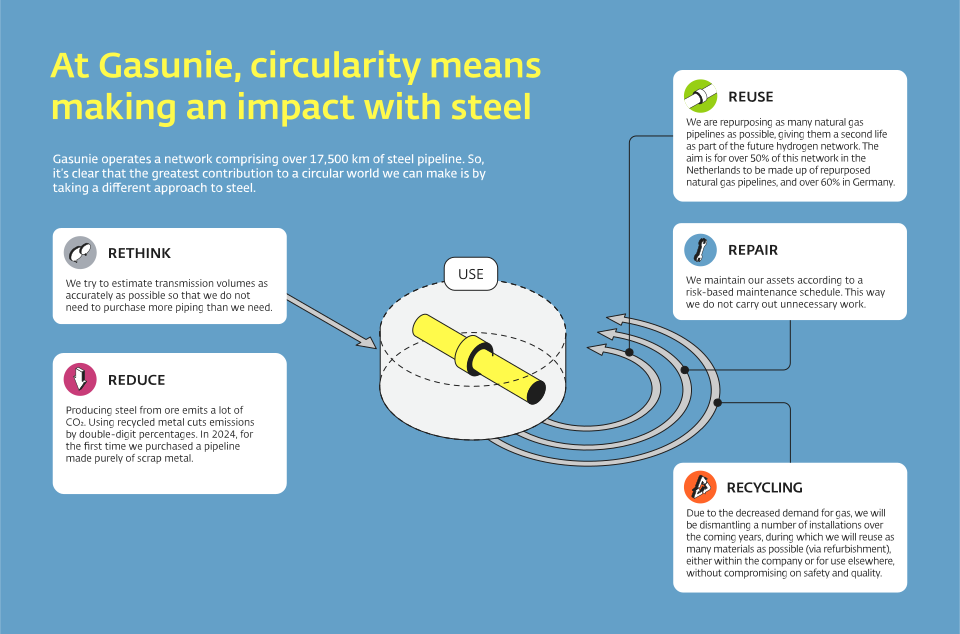
Circularity at Gasunie
Reuse of assets (LT)
Between now and 2030, we are aiming to convert many hundreds of kilometres of steel gas pipelines in the Netherlands and Germany, which are becoming redundant due to falling demand for natural gas, into hydrogen pipelines. These pipelines may possibly remain in use for several decades after repurposing. In the two decades after 2030, we may be able to repurpose many more gas pipelines as demand for natural gas declines and demand for hydrogen increases. In dismantling projects, we are looking to see whether we can recondition components to give these a new life within or outside Gasunie (reverse logistics).
Procurement (LT)
In order to gain insight into the level of circularity of our network components, our purchasing agents are actively engaging with suppliers to find out how the steel in these components is produced. In the steel industry, production methods provide a good indication of the proportion of secondary materials used in the steel. In order to determine the exact proportion of secondary materials, we used to request material passports from our suppliers. However, this year we discovered that the steel market prefers to use Environmental Product Declarations (EPDs) rather than material passports.
Switching from material passports to EPDs has given us greater insight into the total proportion of secondary materials in the network components we procured in 2025. For components for which no EPD was available, we asked our suppliers how the steel in these parts was produced. This showed that more network components than previously thought are manufactured using steel from an electric arc furnace, which is a production method that uses almost exclusively secondary steel.
Resources
Gasunie is currently working on a programme to further put the concept of circularity into practice. Among other things, we are mapping out which resources and investments are needed to achieve the objectives stated in the sustainability strategy.
Measurable targets
Our goal is to start initiatives as high up the MacArthur Foundation's 10R ladder as possible. This model describes ten levels of circularity, from the most sustainable strategy (the top rung of the ‘ladder’) to the least (the bottom rung). The higher up the ladder, the higher the circularity score.
- Refuse
- Reduce
- Redesign
- Reuse
- Repair
- Refurbish
- Remanufacture
- Repurpose
- Recycle
At Gasunie, we do not consider the 10th option from the MacArthur model, i.e. ‘Recover’, to be circular. Our aim is for all our assets and components to at least be recyclable. We consider a product or component to be circular if it falls within one of the highest nine levels of the 10R model. All targets are based on this model and must increase Gasunie’s overall circularity score.
We aspire to have 100% circular operations by 2040. This is sooner than the target year set by the Dutch government. As an interim target, we aim to purchase 50% less primary steel feedstock by 2030. Within our new circularity programme, we have set additional, specific targets to be able to monitor progress against a yet-to-be-determined base year.
Gasunie purchases significant quantities of steel each year. We are working with our suppliers to reduce the use of primary raw materials and close the materials loop. One example of this is the joint tendering process that Gasunie Nederland and Gasunie Deutschland completed in December 2025 for the supply of onshore pipelines. This contract was awarded based not only on the price-quality ratio, but also on sustainability credentials. The use of secondary scrap materials in steel manufacturing, for example, can deliver a CO2 reduction of over 80%. In the circularity programme we plan to set up, we will set concrete targets with a view to extending service life and promoting product and material innovation.
Achievement of our goals
In 2025, we worked on the first sections of the planned hydrogen network both in the Netherlands and Germany. In the Netherlands, this saw us lay new pipelines for the Rotterdam section of the hydrogen network. In Germany (Hyperlink-1), we had converted a total of 171 km of natural gas pipelines into hydrogen pipelines by the end of 2025 (2024: 150 km).
The comparative figures for 2024 have been adjusted following the correction of an error. In 2025, we found an error in the quantity of steel purchases that was recorded when posting an invoice at year-end 2024. As a result, the reported quantity of steel and the share of recycled materials in the 2024 annual report have now been reduced as follows: total steel weight (in tonnes) from 21,216 to 19,395 and recycled materials (scrap) for purchased steel (in tonnes) from 2,801 (13.2%) to 2,473 (12.8%).
In 2025, we were also able to further optimise the calculation method for the kilograms of steel, as better data became available and we were able to extrapolate data on product category level. This extrapolation led to the comparative figures turning out significantly lower. The Sustainability Statement Appendix sets out the principles used in calculating the kilograms of steel. Based on this new calculation method, the comparative figures have been revised from 19,395 to 13,528 and from 2,473 (12.8%) to 1,700 (12.6%).
Our resource inflows12 in 2025 were as follows:
| Resource inflows | 2025 - GU | 2024 - GU |
|---|---|---|
| Total weight of steel (in tonnes) | 56,171 | 13,528 |
| Total | 56,171 | 13,528 |
| Resource inflows | 2025 - GU | 2024 - GU |
|---|---|---|
| Recycled materials (scrap) used for the steel produced, absolute (in tonnes) | 12,716 | 1,700 |
| Recycled materials (scrap) used for the steel produced, percentage (%) | 22.6% | 12.6% |
12 Figures recognised regarding the total weight of steel (in tonnes) and the recycled materials (scrap) were calculated based on the ‘Assumptions in calculating the kilograms of steel and recycled materials used for the steel procured’ (see the Sustainability Statement Appendix).
The increase in total steel weight (in tonnes) and recycled materials (scrap) for procured steel (as an absolute figure and as a percentage) is mainly due to the volume of steel procured by GUD for its new pipeline (ETL 182), which has a length of approximately 87 kilometres. The percentage of recycled material (scrap) of the steel procured was determined based on the EPD provided with the steel.