Foreword by the Executive Board
Foreword by the Executive Board
New energy in a changing world
Geopolitical developments are greatly impacting the market and society in which we operate. Since 2022, when there were disruptions in filling up gas storage facilities, followed by the Nord Stream pipeline sabotage that exposed just how vulnerable Europe’s energy infrastructure is, we have seen energy increasingly being used as a geopolitical leverage tool. In 2025, this development was followed by the use of trade tariffs, hybrid warfare and feedstock politics. At the start of 2026, unrest continues to dominate the gas market, with the conflict involving Iran posing a potential challenge to fill Europe’s seasonal gas storage facilities.
Gasunie keeps pace with this rapidly changing world, so that businesses and households across north-western Europe continue to be assured of reliable access to energy. We do this by building on decades worth of diversification that started with the construction of the Dutch national gas transmission network and also includes the development of gas storage facilities, LNG terminals and the scale-up of cross-border connections to Germany and the United Kingdom. All of these activities have given us a solid foundation from which we can focus on interconnecting various energy carriers and infrastructures, such as pipelines, terminals and storage facilities, empowering suppliers to get energy to their customers in multiple fossil, low-carbon and sustainable forms, with the lowest possible risk of disruptions.
In a different context, the energy transition has gained additional urgency. It has become a crucial means to an end, i.e. to make our society more independent and stay competitive on the global stage, while at the same time combating global warming. We will be putting this into practice in 2026 and 2027 by transporting and storing new energy on a large scale, alongside natural gas. Porthos is set to become one of the European Union's first functioning CO2 transport and storage systems. Following the investment decision in 2023, the Rotterdam Hydrogen Network will give the European hydrogen economy a significant boost from 2026 onwards. And the first phase of the WarmtelinQ heat network is also nearing completion.
At the same time, we work to guarantee energy security and keep energy affordable. Increasing LNG capacity at Gate terminal, developing the German LNG terminal and the preparations for the possible extension of the operational period for EemsEnergyTerminal will strengthen the European energy system’s resilience and flexibility. This is urgently needed, as EU Member States are set to completely stop importing Russian pipeline gas and LNG.
Protecting our infrastructure against all forms of sabotage that threaten the undisrupted supply of energy is also something we are closely focusing on. Electricity, natural gas and supporting digital networks are all interconnected, meaning that failure in one system can have domino effects on others. Digitalisation and automation increase complexity and the risk of cyberattacks. We are working closely together with Dutch and European fellow transmission system operators, ministries and other government bodies to protect our vital infrastructure and safeguard the continuity of our energy supply.
Security and solutions for businesses and households
By transforming from a gas transmission system operator to an energy infrastructure company, we are able to offer energy security for industry and households, and create solutions to sustainability challenges. We are building an affordable, reliable, sustainable energy system, both for now and for the future. Over the coming years, we expect to make significant progress.
We are bringing essential energy transition infrastructure to life, with hydrogen projects such as the Dutch hydrogen transmission network, Hyperlink, HyStock, ACE Terminal and Delta Rhine Corridor. Along with future CCS projects, i.e. Aramis, CO2Next, Delta Rhine Corridor and Delta Schelde CO2nnection, these projects will make up the backbone of a new, more sustainable economy.
This is how we help industries decarbonise thanks to sufficient access to growing volumes of biomethane and are getting ahead of the curve in positioning the Netherlands as a leading sustainable energy hub in north-western Europe. WarmtelinQ is the sustainable heat network that we are creating to provide households and businesses in the province of Zuid-Holland with cleaner and more easily accessible heat, while at the same time reducing natural gas consumption.
Affordable networks for economic growth and diversification
Gasunie is actively engaging with Dutch and European policymakers and regulatory authorities as they develop the policy frameworks for our pioneering projects. Our aim is to guarantee predictable and affordable network tariffs and keep investments in hydrogen, CO2 and heat infrastructure manageable. By working closely together with government bodies and regulators, we aim to guarantee affordable access for the users of our new networks, thus helping European industry to stay competitive.
We welcome the growing recognition of how important industry is for the Netherlands, as set out by the Wennink report that was published in December 2025. We see this report as a key guiding document for the new Dutch government, specifying four enabling conditions for investments and growth. One of these enabling conditions is providing access to affordable and reliable energy in the long term through a diversified energy system where electrons and molecules exist side by side, with sufficient energy storage capacity as a buffer.
Gasunie is also advocating for a diverse energy mix. Electrification is coming up against its limits. Due to the slowing energy transition and persistent power grid congestion, we are going to need natural gas for longer than anticipated, as alternatives to both natural gas and electricity are not materialising fast enough. As a result, businesses and households are unable to go sustainable as quickly as they might want. Gas consumption levels have been falling over the past five years not so much due to sustainability measures or electrification, but rather due to reduced economic activity, i.e. less production and even companies ceasing operations altogether. This is not making the Netherlands any stronger. An energy system that combines electricity and sustainable gases, and makes the most of the existing infrastructure, is faster to develop, more affordable and far more robust. By linking wind power generation to hydrogen production, we can use more energy from wind farms, which will improve affordability. This way the energy transition will still be feasible, affordable and reliable for all.
Along with the need to broaden our energy mix, we are looking into specific solutions that we can already use now to increase affordability and feasibility. One such solution is provided by hybrid heat pumps: they reduce grid congestion and keep costs under control, because they cover most of the heat demand using electricity and only use gas during times of peak demand. Two billion cubic metres of biomethane would be enough to make as many as four million households fully climate neutral using hybrid heat pumps.
Low-carbon hydrogen, also known as ‘blue hydrogen’, can play another key role here, as it is more affordable and enables decarbonisation in hard-to-abate sectors were electrification is not feasible, such as oil refineries and the petrochemical industry, which are currently still using grey hydrogen. On top of that, hydrogen can also be used to help balance the power grid, for example at large power consumers, such as data centres. This will give such companies a greater choice of locations in areas where the power grid is currently full and cannot accommodate new connections, and it will accelerate implementation of new projects.
Our networks offer options for affordable short‑term CO2 reduction. In 2025 Tata announced its plan to phase out coal by 2030 and switch to natural gas as a first step. With this, we contribute to Tata’s ambition to reduce more than five megatonnes of CO2 emissions annually— approximately five percent of the Netherlands’ total CO2 emissions. Gasunie Transport Services can deliver this major connection on time.
Finally, gas-fired power stations will continue to be needed to top up the growing share of solar and wind power, and guarantee security of supply. In the future, these power stations will reduce their use of natural gas by switching to alternatives such as hydrogen. Additionally, carbon capture and storage (CCS) will store captured CO2 under the North Sea bed. Projects such as Porthos and Aramis will create storage capacity for roughly half of all industrial carbon emissions in the Netherlands over the coming years.
Changes to our organisation
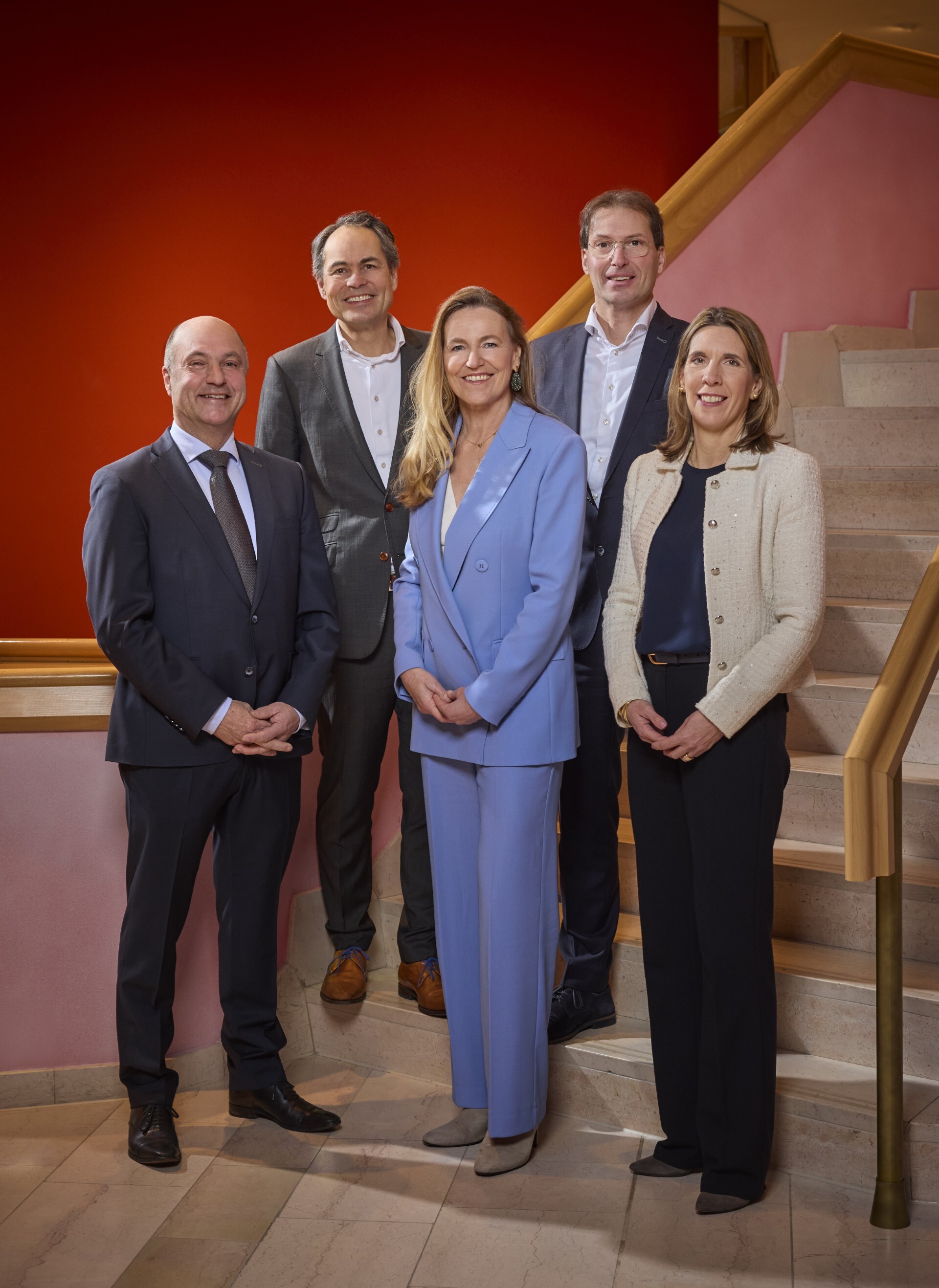
Our strategic course not only requires investments in infrastructure, but also means that we have to change our organisation. As of 1 January 2026, we have turned the page on our structure made up of three business units – Gasunie Transport Services, Gasunie Deutschland and Participations – and switched to an operating model with six business lines: methane transport, hydrogen transport, CCS, heat transport, storage and terminals, and Gasunie Deutschland (which is responsible for methane and hydrogen transport in Germany). This organisational change will help simplify our working methods and forge a culture where taking ownership of results and teamwork are the norm. Following several board changes last autumn, our Executive Board is now made up of a CTO and two COOs besides the CEO and CFO, taking the number of members from four to five.
Aiming for zero accidents
We worked with great dedication and enjoyment in 2025, both in our day-to-day operations and on our major expansion projects. To keep this momentum in 2026, it is crucial that we maintain a keen focus on workplace safety. After all, everyone who works for Gasunie must be able to return home safe and sound at the end of the day. In 2025, and for the first time in several years, we managed to reduce our lost-time incident rate to below our internal standard. We continue to work on bringing down the number of accidents.
Focus for 2026
For 2026, our focus as the Executive Board will be on further reinforcing our position in the energy transition by highlighting the significant cost benefits and flexibility advantages of storing and transporting energy in the form of molecules, blue hydrogen as an example, in an integrated energy system. To improve the safety, quality, cost control and scheduling of our capital intensive new build projects, we have established a dedicated Large Projects department. In addition, the development of Aramis and the Delta Rhine Corridor will be given high priority this year. Also, we will maintain our focus on what we have been doing for over 60 years now: providing energy security.
In 2026, we will continue to embed artificial intelligence (AI) across our operations. AI enhances the safety, reliability and efficiency of our infrastructure and supports employees in the field, control rooms and office functions. We are accelerating adoption along four pathways: network control, market and customer processes, maintenance, and projects. AI enables real time energy flow analysis, supports technicians through digital assistants, and speeds up project preparation and execution, while also improving office processes. Responsible use, data governance, a human in the loop approach and training remain central. This positions AI as a strategic core competence for a safe, affordable and sustainable energy system.
New energy for a prosperous society
In our view, reinforcing the energy system’s resilience and making industry and the built environment sustainable are part of the overriding effort to support a flourishing and resilient economy: new energy for a prosperous society. We are proud that we were able to make significant progress in all these areas last year. We would like to thank our colleagues, fellow transmission system operators, customers and other collaborative partners for all their efforts over the past year. Without them, we cannot build the future.