
Governance
Governance
Corporate governance is all about the way that Gasunie is run, about how management is supervised and how we render account. A clear governance structure helps Gasunie realise its objectives effectively and efficiently, and look after the interests of all its stakeholders. It is also a key precondition for risk management.
Corporate governance at Gasunie
The governance of N.V. Nederlandse Gasunie is based on the mitigated structure regime and the governance structure is based on Book 2 of the Dutch Civil Code, the Dutch Corporate Governance Code, the company’s articles of association and various internal rules of procedure. The Dutch Gas Act (until 1 January 2026) and the Dutch Energy Act (from 1 January 2026) also include several provisions affecting Gasunie’s governance structure.
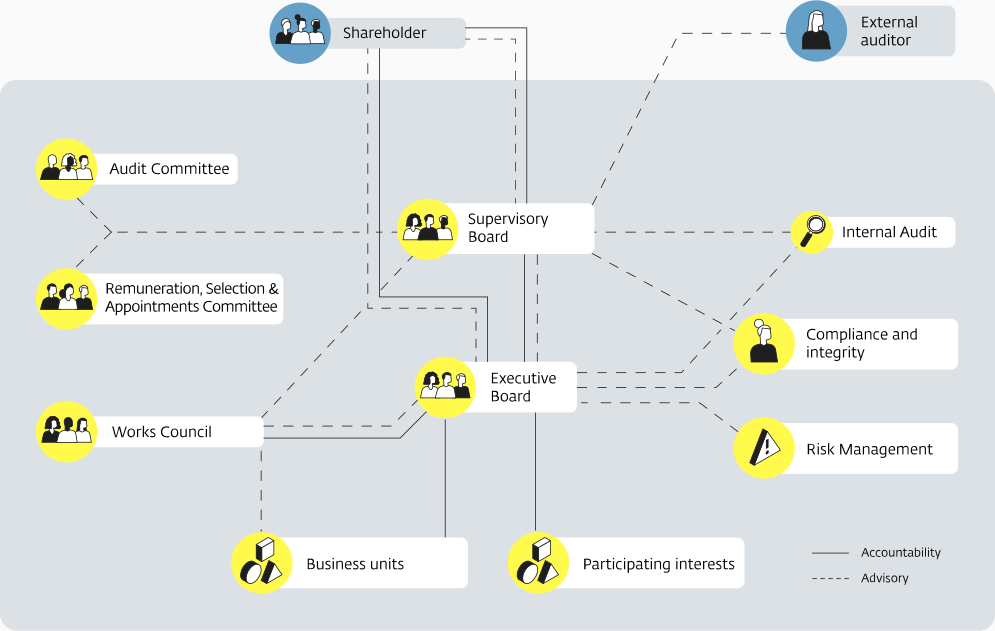
Our corporate governance structure
-
Shareholder
N.V. Nederlandse Gasunie (Gasunie) is a public limited company whose sole shareholder is the Dutch State, with the Ministry of Finance fulfilling the shareholder function.
-
Supervisory Board
The Supervisory Board is tasked with monitoring the policy set by the Executive Board and the general state of affairs at Gasunie and its affiliated companies. The Supervisory Board advises the Executive Board and sets the remuneration and terms of employment of the Executive Board members. In accordance with the Dutch Gas Act/Energy Act and the company’s articles of association, the Executive Board also submits certain decisions to be made concerning GTS and other subsidiaries to the Supervisory Board for approval. At year-end 2025, all members (100%) of the Supervisory Board satisfy the requirements of independence within the meaning of the Dutch Corporate Governance Code. The Supervisory Board has rules of procedure in place that govern the principles and best practices of the Supervisory Board.
-
Audit Committee
Made up of members of the Supervisory Board, the Audit Committee advises the Supervisory Board on the integrity and quality of Gasunie’s financial and sustainability reporting, as well as on the effectiveness of internal risk management and control systems at Gasunie and its affiliated companies. From time to time, the Audit Committee takes a more in-depth look at certain topics such as AI and major projects such as Porthos and German LNG.
-
Remuneration, Selection & Appointment Committee
The Remuneration, Selection & Appointment Committee consists of members of the Supervisory Board. They advise the Supervisory Board on Executive Board remuneration and oversee leadership development. Additionally, the Remuneration, Selection & Appointment Committee oversees the composition of the Executive Board and the Supervisory Board and prepares succession plans. This committee establishes selection and appointment criteria for members of the Supervisory Board and the Executive Board, and conducts periodic performance reviews with (individual) Supervisory Board and Executive Board members.
-
Executive Board
The Executive Board oversees the general operations of Gasunie and its affiliated companies. It is the Executive Board’s responsibility to see to it that Gasunie achieves its goals, as well as to shape the strategy and policy needed to be able to achieve those goals. The Executive Board has rules of procedure in place that govern the principles and best practices of the Executive Board.
-
Business units and associate entities
The management teams at the business units and associate entities in which Gasunie holds a participating interest are responsible for their respective unit’s or associate entity’s day-to-day operations. This means that the management team is responsible for achieving operational and other goals, and for drawing up the business plan to enable achievement of these goals.
-
Works Council
The Works Council has a dual task. On the one hand, it is a consultative partner to the Executive Board, raising ideas and providing input when discussing the items on the agenda, and is a sparring partner in decision-making regarding social and economic matters. On the other hand, the Works Council represents the employees. Depending on the matter being handled, the Works Council has the right to prior consultation, the right to consent, the right to make proposals or the right to be informed. In 2025 the Works Council met with members of the Executive Board on six occasions, with a member of the Supervisory Board also sitting in at two of these meetings. Each year, the Works Council, the Executive Board and the Supervisory Board participate in a joint knowledge session. The additional information includes the Report of the Works Council, in which the Works Council looks back on its activities in the year 2025.
-
External auditor
-
Internal Audit
The Internal Audit department provides the management teams, Executive Board, Audit Committee and Supervisory Board with an independent and objective understanding of the maturity of Gasunie’s management control system and assurance on the effectiveness and efficiency of governance, risk management and internal control systems in and around the business processes of Gasunie’s business units and associate entities.
-
Compliance & Integrity
Overseeing compliance and integrity risk control, the Compliance & Integrity department supports the Executive Board and management teams in ensuring compliance with current and new laws and regulations, as well as in promoting a culture of integrity and safeguarding controlled business operations.
-
Risk Management
Risk Management is responsible for managing and maintaining the integrated risk framework and for overseeing its implementation. The Risk Management department also coordinates corporate, business and operational risk analyses and the implementation of internal control plans.
Codes and schemes
Dutch Corporate Governance Code
Gasunie applies the provisions of the Dutch Corporate Governance Code (‘the Code’). Although, strictly speaking, the Code is only applicable to listed companies, Gasunie follows the principles and best practice provisions of the Code on a voluntary basis if they are relevant and applicable to Gasunie.
Many of the principles and provisions of the Code have been included in our articles of association and in various rules of procedure. See the Gasunie website for an ‘apply or explain’ overview explaining our application of the Dutch Corporate Governance Code.
Conflicts of interest
Gasunie complies with best practice provision 2.7.4 of the Dutch Corporate Governance Code, which stipulates that transactions involving conflicts of interest of members of the management board or supervisory board that are of material significance for the company or the relevant board members must be disclosed in the management report. There were no transactions of this nature in 2025.
Speak Up scheme
Gasunie’s Speak Up scheme is intended to enable people to safely report anything that happens that is contrary to Gasunie’s rules, principles or core values. Anyone who comes into contact with Gasunie through their work, like our own employees and the employees of suppliers or contractors, can file a report. We actively raise awareness of the Speak Up scheme among employees each year through workshops and news bulletins on Gasunie’s intranet site for Gasunie employees and on the Gasunie website for supplier and contractor employees. Every employee in the Netherlands has followed an eLearning course on inappropriate behaviour, integrity and how to report incidents and raise concerns.
2 incidents were reported under the Speak Up scheme in 2025 (2024: 3). All these reports were followed by consultation between the person making the report and the Corporate Compliance & Integrity Officer about the handling of the matter reported.
Confidential counsellors
Gasunie has six certified, internal confidential counsellors and one external confidential counsellor coordinator. They can be consulted confidentially by employees, including agency workers and external service providers who perform work for Gasunie. In 2025, a total of 34 people (2024: 56) consulted the confidential counsellors, raising a total of 36 (2024: 67) matters, of which 25 (2024: 43) related to inappropriate behaviour, 2 (2024: 5) to integrity issues and 9 (2024: 19) to other matters (labour conflicts, psychosocial problems, problems in their private life).
In Germany, Gasunie employees can submit reports, anonymously if they want, to six confidential counsellors, an equal opportunities officer, the Betriebsrat (Works Council) or the HR department. Gasunie Deutschland received 1 report of inappropriate behaviour in 2025 (2024: 1).
Conduct Guidelines – Working Together
The Conduct Guidelines – Working Together set out how we aim to work together in a constructive and pleasant way on creating a fully sustainable energy supply. While most of the guidance speaks for itself, it is always good to make sure we are all on the same page as to what we can expect from each other. Intentional violations of integrity provisions warrant appropriate consequences.
In 2025, we found no incidents of bribery or corruption (2024: none).
Given that human trafficking, forced labour, child labour and human rights are covered in both the Dutch and German constitution and laws on workplace health and safety, the latter of which contribute to the protection of employees and ensure safe and healthy working conditions, we do not have a specific policy on these matters. Our policy with regard to employees is not explicitly aligned with the UN Guiding Principles on Business and Human Rights.
Gasunie Supplier Code of Conduct
The Gasunie Supplier Code of Conduct sets requirements for suppliers regarding human rights, working conditions, health and safety, the environment and ethical business practices. We expect every single company that we do business with, as well as their suppliers, to meet the standards laid out in the Gasunie Supplier Code of Conduct. Compliance with this code is a prerequisite for doing business with us.
Governance and risk management
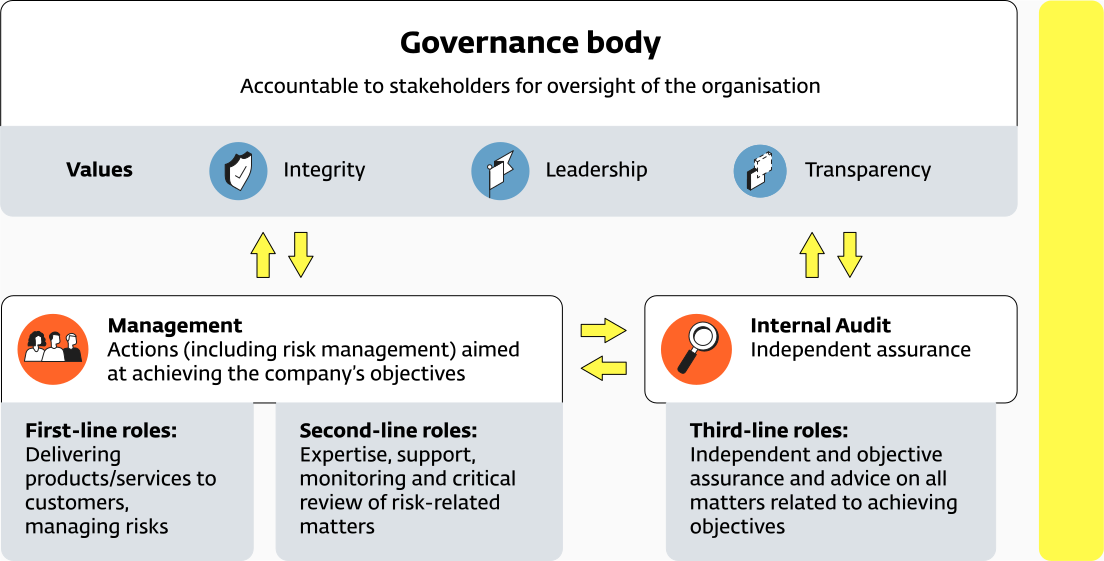
Gasunie’s risk management is organised based on the Three Lines Model. The Executive Board has final responsibility for risk management and is accountable for this to the Supervisory Board and the shareholder through the annual Document of Representation (DoR) letter. The Supervisory Board regularly talks to individual members or the entire Executive Board about governance and risk management, addressing things such as important risks and audit results. As a result, risk management is an activity that is performed at all levels of the organisation. The Three Lines Governance Model makes it clear where the various risk management process responsibilities lie.
Risk management framework
Gasunie manages its risks based on a risk management framework. To be able to effectively consider risks in operations, it is important to use an overarching framework that guides all risk management efforts within the organisation. Gasunie has opted to shape its risk management, including internal control, based on the Enterprise Risk Management (ERM) framework, We used the COSO (Committee of Sponsoring Organizations of the Treadway Commission) 2017 ERM framework in setting up and rendering account on the Gasunie ERM framework.
Risk culture
Gasunie manages new and changing risks using a risk management framework rooted in a risk-aware organisational culture The Three Lines Model reinforces risk awareness through a clear distribution of risk management roles and responsibilities across the first, second and third line of defence, thus ensuring that risk management is consistently factored into decision-making.
Risk appetite
Every year, the Executive Board establishes Gasunie’s risk appetite with regard to its strategy. In so doing, we make a statement about the extent to which Gasunie is prepared to take risks to attain its strategic objectives. We furthermore apply a number of general principles that cut across the strategy and that Gasunie must satisfy at all times. Our risk appetite is a guideline in our strategic and operational decision-making.
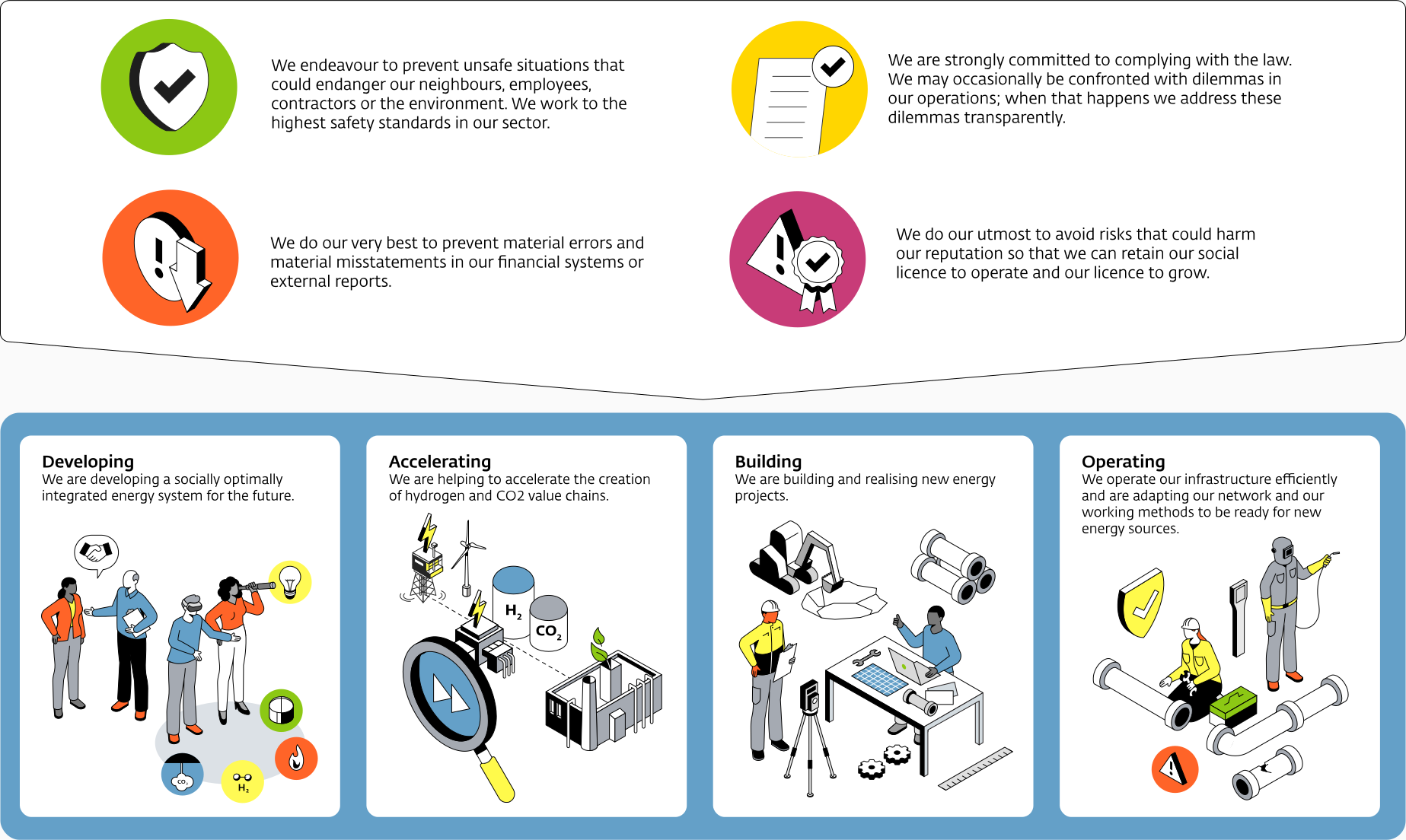
Gasunie feels responsible for facilitating the energy transition and increasing transmission security in times of climate change and geopolitical unrest. This means that Gasunie is prepared to take greater risks, in certain areas, than previously.
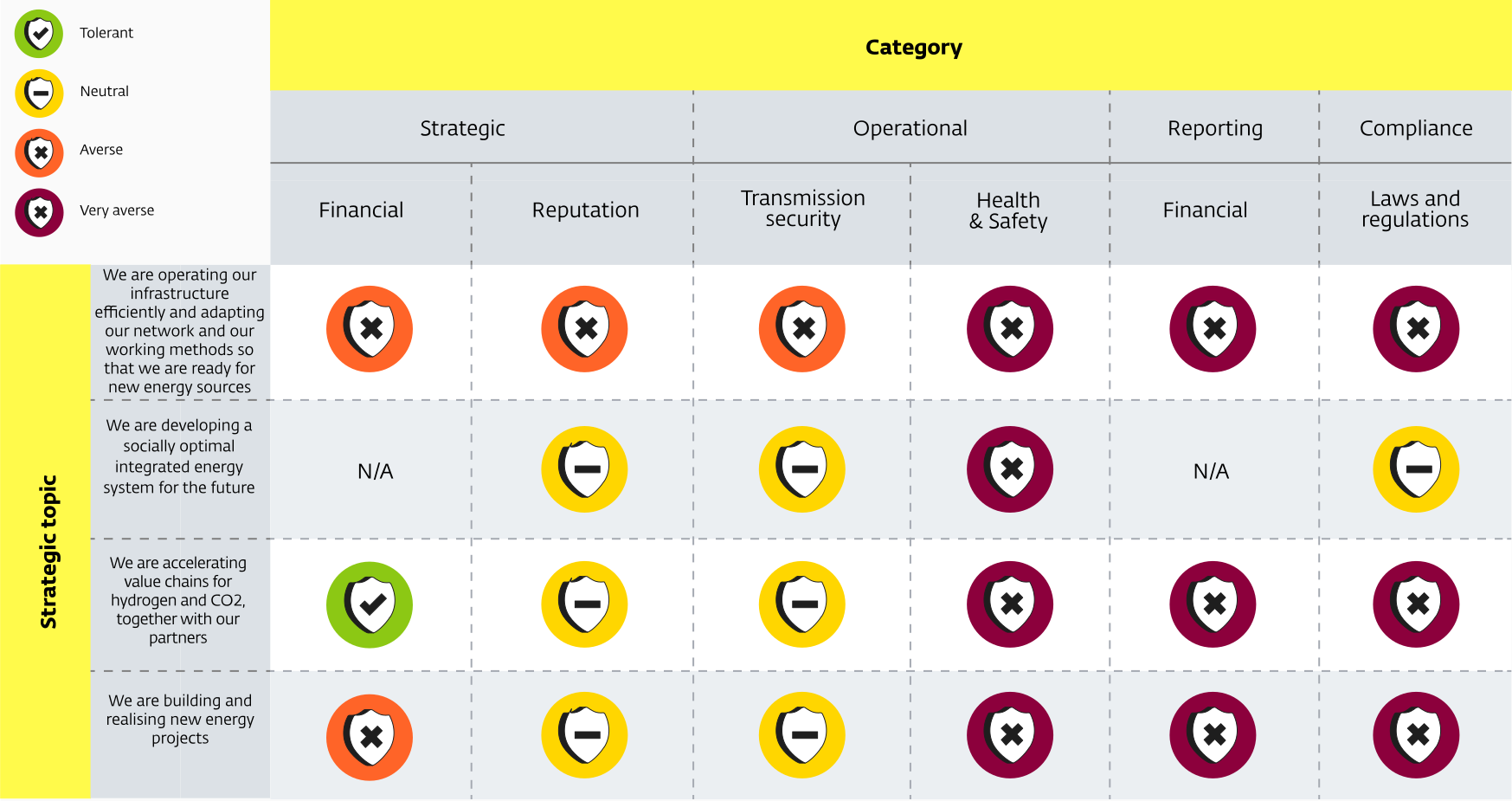
Gasunie’s risk appetite
-
Tolerant
Activities for which Gasunie is willing to take risks as the potential opportunities outweigh the potential downsides. We take calculated risks and are risk-tolerant so that we can achieve our goals.
-
Neutral
Activities for which Gasunie is constantly looking for the right balance between potential opportunities and potential risks. We accept that these risks may occur with a moderate likelihood and/or impact. To manage risks we deem unacceptable, we have implemented control measures that focus on both preventing and detecting these risks (preventive and detective control measures).
-
Averse
Gasunie has little to no risk appetite for these activities. This means we always aim to have effective controls in place with respect to these risks. Control measures have been implemented to prevent the risk, and detective control measures are in place to take action when necessary.
-
Very averse
Activities for which Gasunie has no willingness to take risks. This means we always aim to have highly effective controls in place with respect to risks in this risk area. Control measures have been implemented to prevent the risk, and detective control measures are in place to take action when necessary.
Risk identification
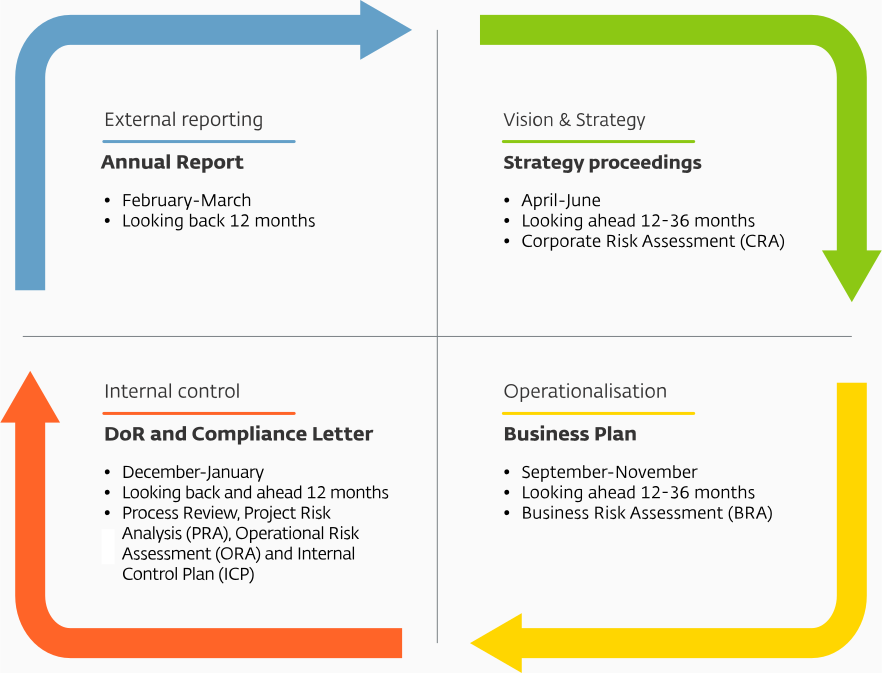
To identify risks and prevent risk events, we run risk analyses at a strategic, tactical and operational level at Gasunie. See below for details of the main risk analysis within the risk management framework:
-
Corporate Risk Analysis (CRA)
Through an annual CRA, we analyse the main corporate (strategic, operational, compliance and reporting) risks that could stand in the way of the implementation of our strategy in the medium to long term and the main strategic opportunities that could positively affect the execution of our business processes. The CRA is an integral part of our corporate business plan, which has a three-year horizon and is reviewed every year.
-
Business Risk Analysis (BRA)
For our business units and service providers, we run a BRA each year focused on strategic, operational, compliance and reporting risks. This concerns corporate risks allocated to the relevant business unit and risks that apply specifically to each business unit. The BRA looks at short to medium term risks that could impact the achievement of objectives and is an integral part of our business plans.
-
Double Materiality Assessment (DMA)
We conduct a DMA to identify material impacts, risks and opportunities (IROs) in the context of sustainability. The results of the DMA underpin our sustainability strategy and reporting to ensure we comply with transparency and reporting requirements under the Corporate Sustainability Reporting Directive (CSRD).
-
Process review
Process owners conduct annual reviews of their respective processes, running down a checklist to assess the degree to which they are in control and whether there are opportunities for improvement. The process owner is supported in this by the process manager and other experts. If it emerges from the process review that it would be a good idea to gain more insight into operational, compliance and reporting risks, for example, because the context of the process has changed, we initiate an Operational Risk Analysis (ORA).
-
Project Risk Analysis (PRA)
Strategic and regular projects are subject to a PRA to identify project risks and control measures and to determine management actions. This is intended to reduce project risks within the project timelines and achieve project goals in time, or to intervene to make sure of that.
-
Operational Risk Analysis (ORA)
We subject critical business processes to operational risk analyses to identify operational and compliance risks, including fraud and corruption risks. We record the results of ORAs in the internal reports and audit plans of the departments involved in these processes.
-
Internal control plans
Our internal control plans set out how we test the control measures that emerged from the risk analyses every year. These plans are drawn up annually and support management in its corporate risk management cycle for internal process, system and people management purposes.
Document of Representation (DoR) and compliance letter (CL)
Once a year, the management of each business unit conducts a self-evaluation and issues a DoR and compliance letter to report whether or not the risk framework, internal controls and processes were effective in relation to the strategic, operational, reporting and compliance risks, while explaining any shortcomings and non-compliance they have observed. In doing so, the management of each business unit indicates whether we have taken adequate control measures and whether we have taken any action to improve control.
Based on these underlying DoR and compliance letters from each business unit, a DoR letter and a compliance letter are drafted for Gasunie as a whole. Through this DoR, the Executive Board renders account on the effectiveness of Gasunie’s risk framework, internal controls and processes over the past year in relation to the strategic, operational, reporting and compliance risks. In the compliance letter, the Corporate Compliance Officer outlines the latest compliance and integrity developments at Gasunie. The DoR and compliance letter process and the internal audits performed all feed into the supporting information for the Risk Management Statement. Our risk framework and internal controls have been set up using the COSO 2017 ERM framework.
Further development of risk management
For the purpose of the Risk Management Statement, we have further refined the way we use our risk tools and reporting based on the customised Corporate Governance Code. The Risk Management Statement is issued by the Executive Board, and its preparation has been reviewed with the Audit Committee. The statement is presented in the section “Statement of the Executive Board”. Additionally, we have used a model to assess the level of maturity of our risk management and identify focus areas that will enable us to continue to develop our risk management in 2026. These refinements are geared towards further developing our operational risk analyses and identifying and testing key controls in our operations.
Our main risks
We have mapped out our strategic, operational, compliance and reporting risks based on risk analyses. We have divided the risks into six categories, based on risk appetite:
- Strategic – Financial Risks that could affect our financial health and strategic investments.
- Strategic – Reputational Risks that could negatively impact Gasunie’s image and the external perception of Gasunie.
- Operational – Transmission security Risks that could disrupt the continuity and reliability of transmission services.
- Operational – Health and safety Risks relating to the safety of staff and the protection of the environment.
- Reporting Financial and sustainability reporting risks.
- Compliance Risks relating to compliance with legislation and regulations.
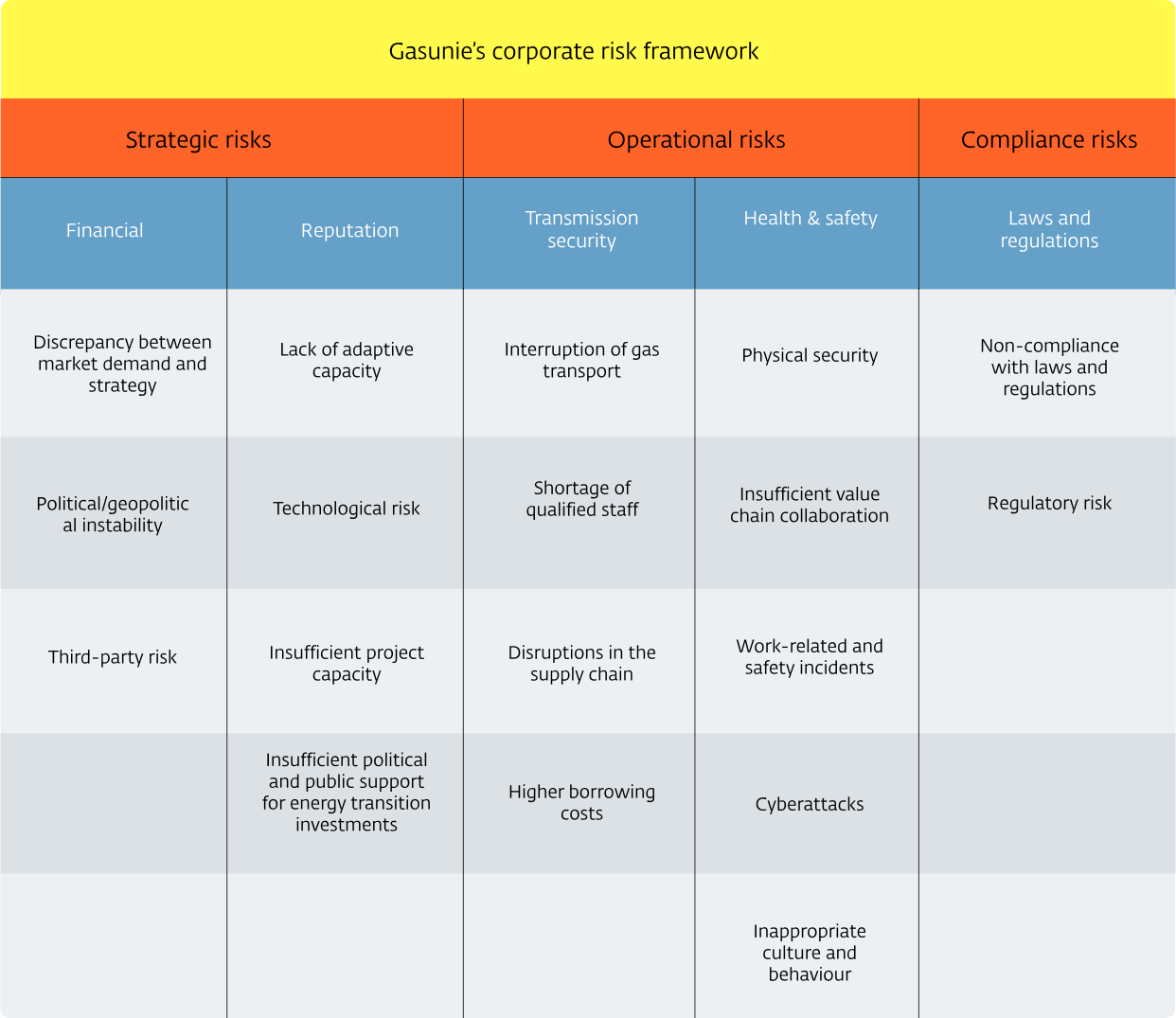
Full risk descriptions are provided in the table below or in the additional information. The mitigating measures for our top ten risks at corporate level are also described in the table below. The risks related to the use of financial instruments are explained in note 23 ‘Financial instruments’ to the 2025 financial statements.
| Risk | Description | Mitigating measure |
|---|---|---|
| Work-related and safety incidents | The risk of Gasunie being unable to properly run new energy projects and complete them in time. This risk results from inadequate procedures, delays in permitting processes or IT system readiness, and a lack of experience, expertise and capacity on project teams, which leads to serious delays in projects, cost overruns, a poor reputation and reduced public support for execution of the strategic investment agenda. | • A special core team made up of an Executive Board member and managers from several departments, among others, actively leads initiatives to foster a culture of safety. • Managers across Gasunie follow the Safety II philosophy, which is geared towards establishing adaptive safety behaviour and fosters a strong culture of safety. • Safety barriers are reinforced using protocols, such as work permits, maintenance regulations and systematic safety improvements |
| Insufficient project capacity | The risk of Gasunie being affected by ongoing political or geopolitical tensions. This risk is caused by government policy and international conflicts that lead to great economic uncertainty and fear of a recession. This instability affects energy tariffs and demand from industry, which may, in turn, lead to lower demand for gas and uncertain market conditions. This results in a slowdown of market development for new energy carriers and a drop in gas revenue. Such instability may, furthermore, lead to (cyber)security incidents disrupting operations. | • Gasunie has an extensive training programme on safety, project phases, checks and end-to-end project implementation. On top of that, we use strategic recruitment and fit-gap analyses to make sure our project teams have all the required expertise on board. • Senior management is actively involved in stakeholder management to ensure consistent risk profiles, as well as effective communication throughout the timeframe of a project. |
| Political/geopolitical instability | The risk of Gasunie falling victim to cyberattacks. This risk is caused by inadequate network security, a lack of employee awareness for digital threats (including ransomware) or hacking techniques. It can lead to disruptions in Gasunie's infrastructure and services. Such disruptions may, in turn, cause widespread interruptions in the energy supply chain and, consequently, society as a whole. This can lead to legal liability, damage to our reputation and financial losses. | • Strengthening organizational resilience: Due to ongoing geopolitical developments, Gasunie is redefining and strengthening its physical safety constantly. • Advising the government on security of supply, taking into account geopolitical tensions and government policies, including on the development of new energy carriers. This is intended to result in a robust energy system with sufficient flexibility. • Monitoring internal and external developments and relying on and/or scaling up our crisis management for business continuity and first-line operational crisis mitigation in connection with physical and cybersecurity risks. |
| Cyberattacks | The risk of Gasunie being confronted with serious physical security issues. These may be caused by having taken insufficient security measures, a lack of resilience against attacks and protests, and/or insufficient staff training in safety/security protocols. It can lead to disruptions in Gasunie's infrastructure and services. | • Ongoing monitoring of new threats and taking additional security measures or adjusting existing ones as and when necessary. • Company-wide programme to raise employee awareness of digital threats. The effectiveness of this programme is reviewed on a regular basis. • We have robust back-up and recovery measures in place to mitigate the impact of cyberattacks and a strategy that develops in step with the IT landscape. |
| Physical security | The risk of Gasunie having insufficient support across society for its strategic initiatives. This can be caused by climate change scepticism and a lack of public support for new initiatives such as CCS and hydrogen. It may lead to projects being aborted or delayed, as well as financial losses and challenges hindering the energy transition. | • Physical measures on site: fencing, CCTV cameras and access control. • Cooperating and sharing information with the authorities. • Continued effective monitoring and taking action in response to physical security attacks, together with our strategic partners. |
| Insufficient public support for investments in the energy transition | The risk of Gasunie facing a discrepancy between demand from the market and its strategy. This may lead to industries leaving Europe due to high energy prices and regulatory challenges. In response to this, we need strategic industrial policy. If this discrepancy occurs, it would become impossible to implement the strategic investment agenda and there would be a decline in growth potential and profitability. | • Gasunie takes an active part in dialogue with government agencies on all levels to reinforce our influence and position in the decision-making process. • Collaboration across various teams and departments to align stakeholder management efforts. |
| Discrepancy between market demand and strategy | The risk of Gasunie lacking the capacity to adapt to changes. This is caused by rapid changes in technology and innovations, such as developments around artificial intelligence, in the industry, a lack of flexibility in strategic planning and misjudgements in responding to trends. It leads to premature depreciation of operating assets, inefficient use of resources and disruption of business activities. | • Several scenarios and stress tests determine the strategic course to minimise the risks. • Gasunie lobbies stakeholders to develop industrial policy on an EU level to keep Europe competitive, minimise the exodus and thus guarantee a stable industrial basis. |
| Lack of adaptive capacity | The risk of Gasunie being unable to recruit qualified staff. This may happen as a result of a rapidly developing energy sector and growth, insufficient focus on recruitment and knowledge retention, staff turnover and a competitive labour market. It leads to operational inefficiencies, employee dissatisfaction and project delays, and it will ultimately have an impact on business continuity and performance. | • Being and staying aware of all developments on the market in terms of new technologies based on Technology Watch and changing our course where necessary. • Get commitments from customers (e.g. through long-term contracts) and the government (e.g. through guarantees or grants) when the time comes to make the final investment decision (FID) to reduce the level of risk in the business case. |
| Shortage of qualified staff | The risk of Gasunie being insufficiently able to work together with customers, internally and with value chain and investment partners. This risk is caused by the energy transition, which faces massive challenges due to shortages of materials, engineering services and contractors, which leads to disruptions in the value chain, missed opportunities on the market and loss of market share or revenue. | • Intensive recruitment and skilling programmes, both across the whole company and at department level, to equip employees with everything they need to do their jobs well. • A buddy system that pairs experienced with new employees to foster knowledge transfer. We also organise regular knowledge sessions. • Recruitment activities on university campuses and closer collaboration within the energy sector strengthen Gasunie’s recruitment position. |
| Insufficient collaboration within the value chain | The risk of Gasunie being insufficiently able to collaborate with customers, internally, and with value chain or investment partners. The energy transition poses significant challenges due to shortages of materials, engineering services and contractors. This may lead to disruptions in the value chain, missed market opportunities and loss of market share or revenue. | • Launching portfolio management initiatives, including new project boards, to streamline the decision-making process throughout the project chain. • By implementing the WESP procurement strategy, we aim to step up collaboration and facilitate the achievement of project goals across the organisation. |
Composition of the Executive Board
Current Executive Board members
As of 1 November 2025, Gasunie’s Executive Board is made up of a Chief Executive Officer (CEO), a Chief Financial Officer (CFO), two Chief Operating Officers (COOs) and a Chief Technical Officer (CTO). Prior to that date, the Executive Board consisted of four members.
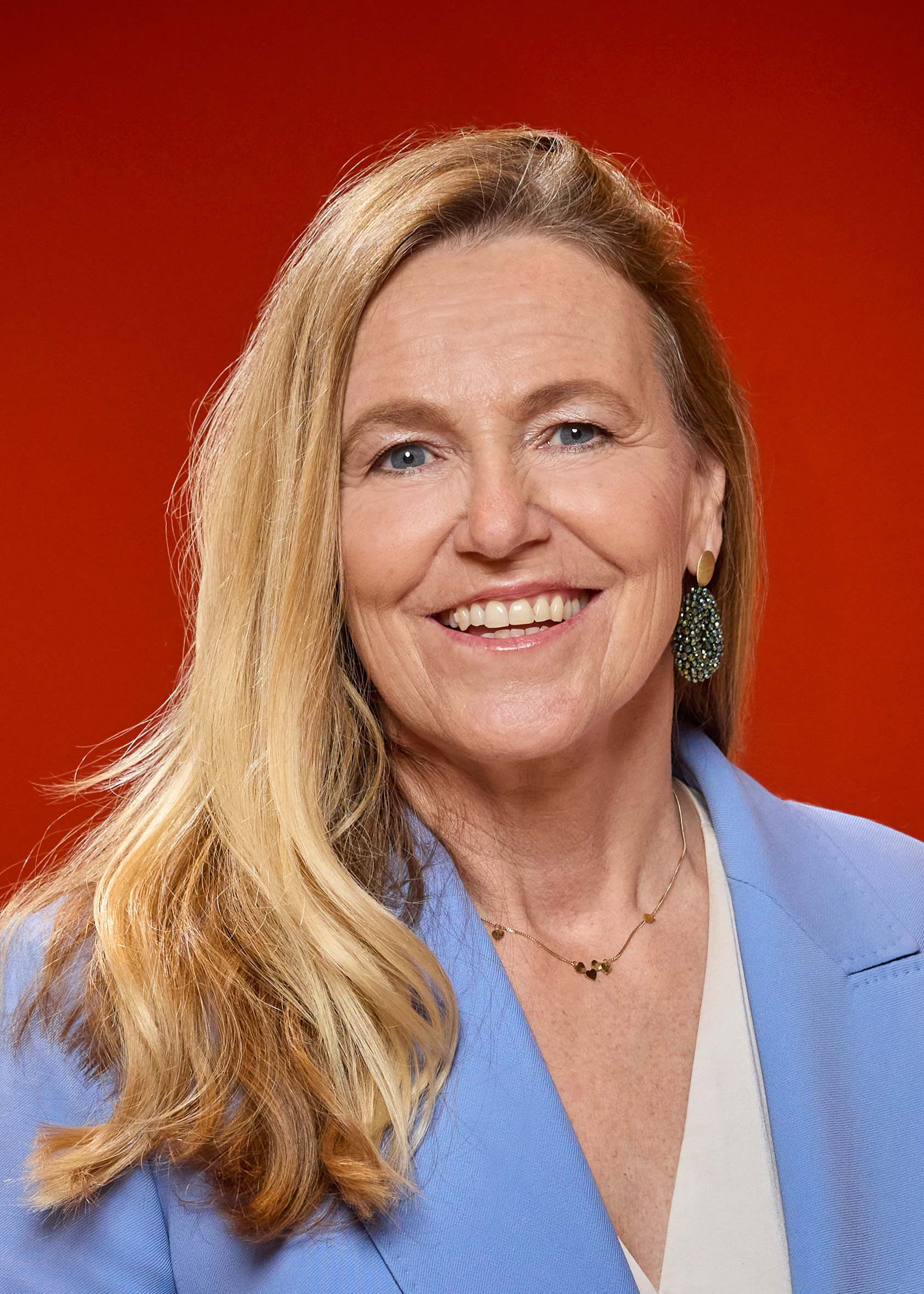
W.R. (Willemien) Terpstra, CEO and Chair of the Executive Board (member required by the articles of association)
(1970, Dutch, F)
Willemien Terpstra joined Gasunie’s Executive Board as CEO and Chair on 1 March 2024. She has been appointed for a period of four years.
As Chair of the Executive Board, Terpstra has certain specific tasks and responsibilities, which are closely related to her coordinating role as CEO and are specified in clause 4.2 of the Rules of Procedure containing the principles and best practices of the Executive Board.
As of 1 October 2025, Willemien Terpstra heads the Strategy, Government Affairs, Communication and Human Resources departments.
Prior to joining Gasunie, Terpstra was chemical giant LyondellBasell’s Global Vice President for Decarbonisation, responsible for sustainability measures, energy savings and carbon emission reduction in the company’s operations worldwide. Before that, she held a large number of senior management positions at several LyondellBasell business units.
Terpstra studied Business Administration at Nyenrode Business University (NL) and obtained her MBA at Emory University in Atlanta (US).
Other positions
- Board Member, German-Dutch Chamber of Commerce (DNHK)
- Member of the Advisory Board, Clingendael International Energy Programme (CIEP)
- Member of Stichting Fondsbeheer Culturele Relatie-evenementen, Groninger Museum
K. (Katie) Slipper, CFO (member required by the articles of association)
(1972, British, F)
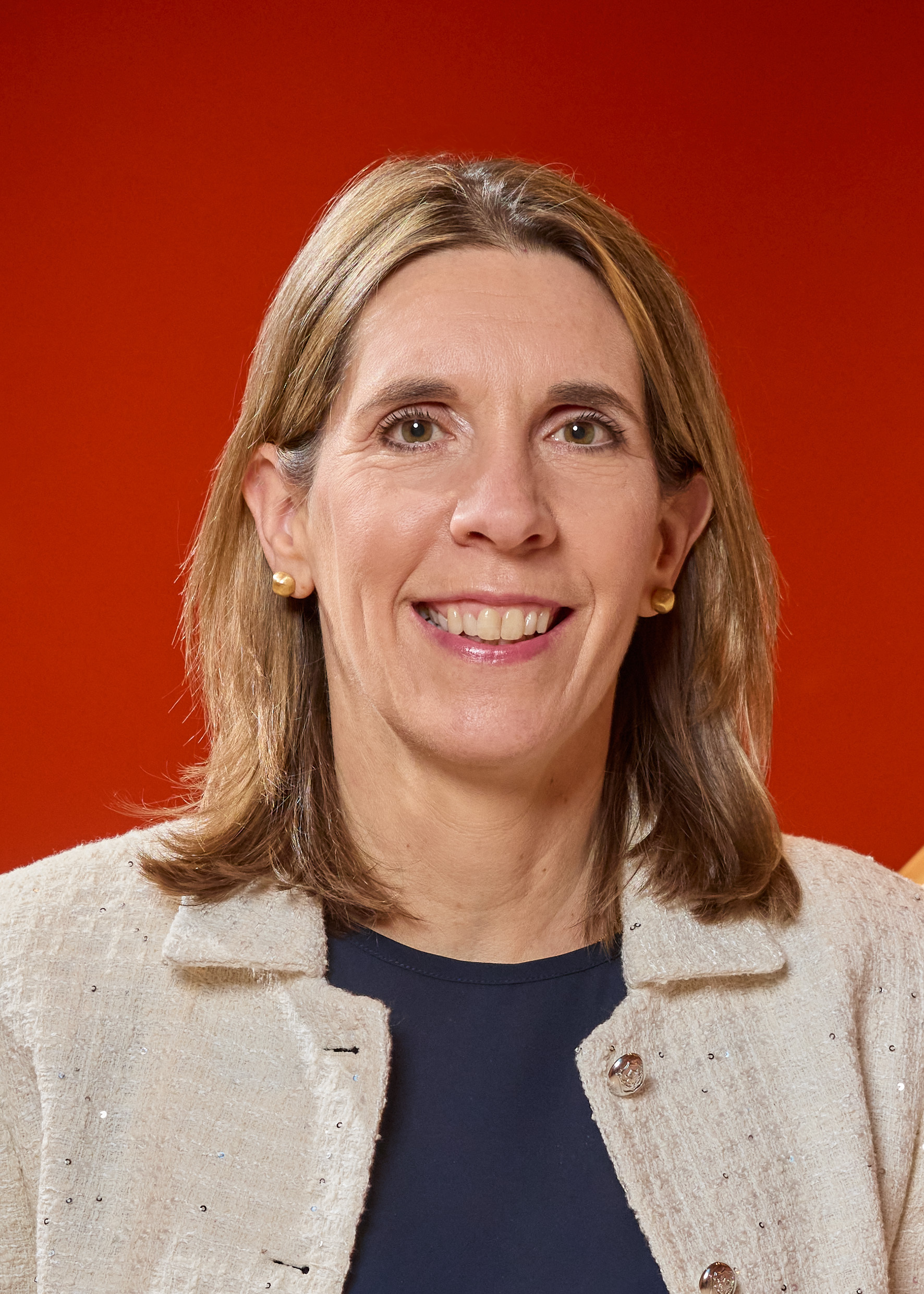
Katie Slipper joined Gasunie’s Executive Board as CFO on 15 January 2026. She has been appointed for a period of four years. She is responsible for Gasunie’s financial policy, rendering account to the Audit Committee and Supervisory Board.
As of 15 January 2026, Katie Slipper heads the Planning & Control, Treasury, Governance, Legal & Compliance, ICT and Internal Audit departments.
Slipper has held several positions at Royal Schiphol Group in the recent past, including that of Finance Director and Risk & Internal Audit Director. Prior to that, she worked at Vopak, including as Global Internal Audit Director.
After studying Geography at King’s College London, Slipper earned her ACCA qualification from the Association of Chartered Certified Accountants.
Other positions
- None
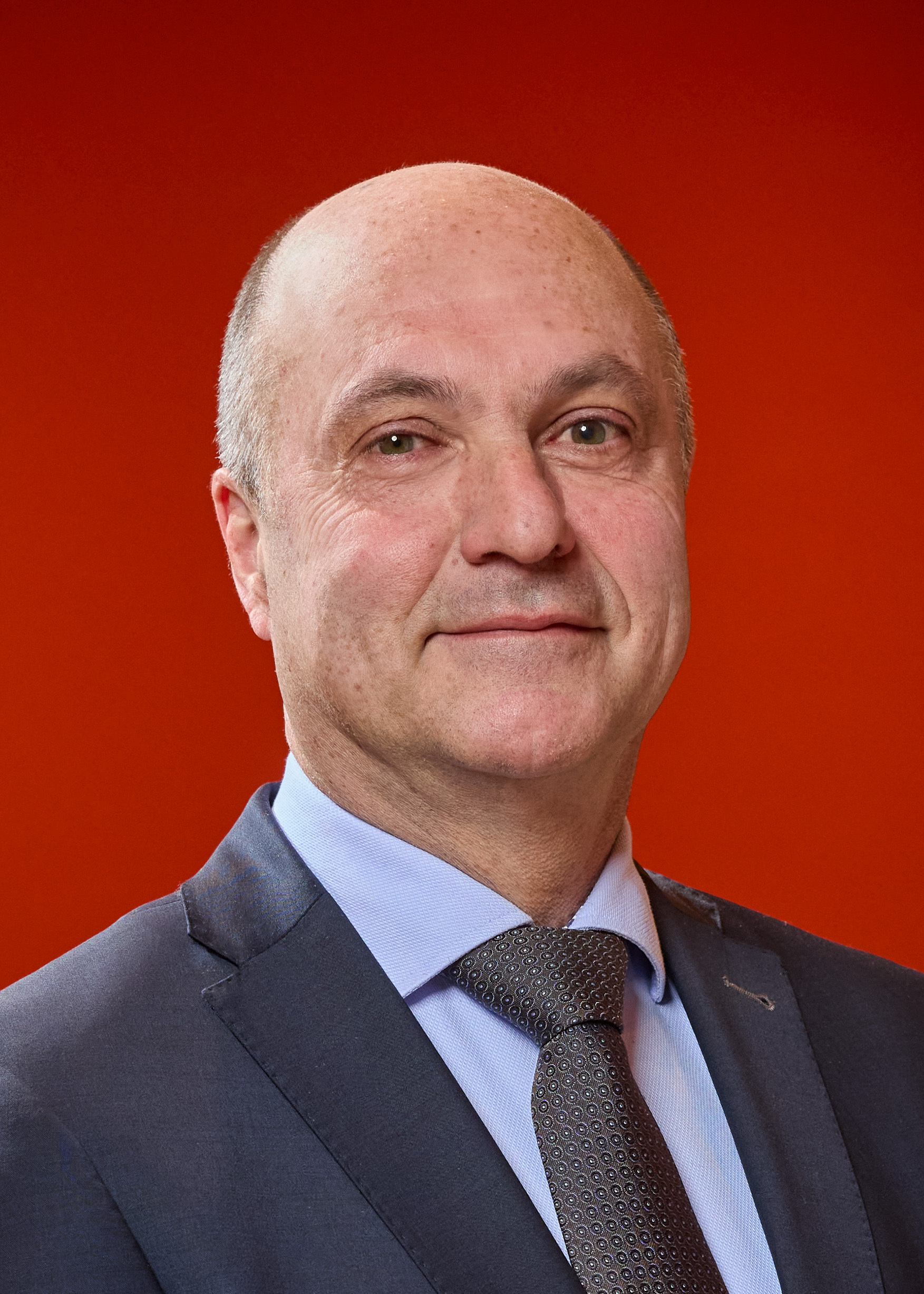
J.A.F. (Hans) Coenen, COO (titular member)
(1966, Dutch, M)
Hans Coenen joined the Executive Board as a titular member on 1 April 2023. He has been appointed for a period of four years. Hans Coenen has worked at Gasunie since 1990, most recently as director of business development and strategy.
As of 1 October 2025, Hans Coenen is responsible for the Methane Transport, Hydrogen Transport and Gasunie Deutschland business lines.
He graduated from Wageningen University with an Engineering degree and also has a Master’s degree in Financial Economics from TIAS Business School in Tilburg.
Other positions
- Chair of the board of the Koninklijke Vereniging van Gasfabrikanten in Nederland (KVGN)
- Council member, International Gas Union
- Chair of the Foundation Executive Committee, New Energy Coalition
- Member of the Executive Committee, EemsdeltaGreen
- Member of the Executive Committee of Vereniging Platform Groen Gas (PGG)
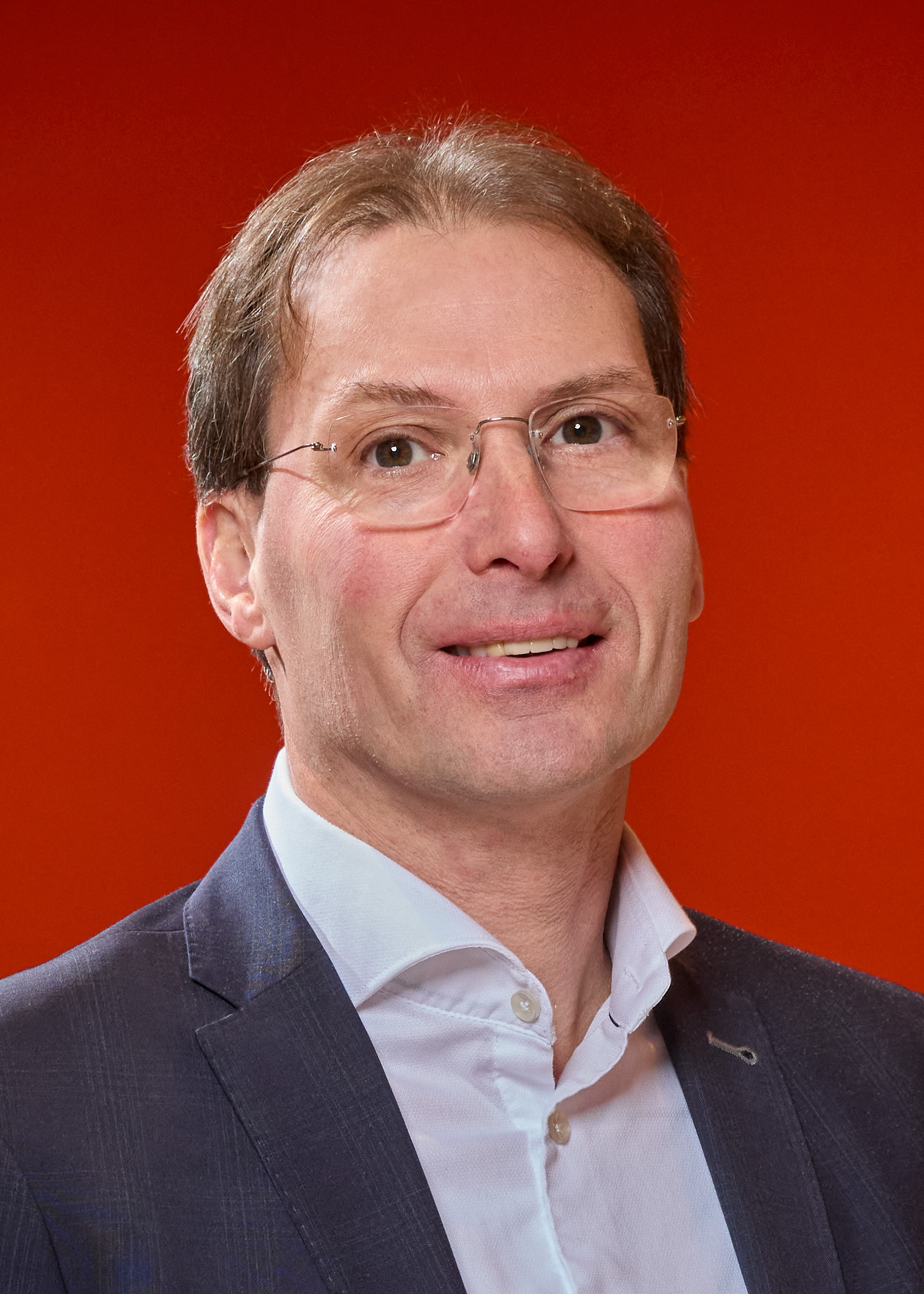
M.W.M. (Marc) van der Linden, COO (titular member)
(1972, Dutch, M)
Marc van der Linden was appointed as COO and member of the Executive Board on 1 September 2025. He has been appointed for a period of four years.
As of 1 October 2025, Marc van der Linden is responsible for the Storage & Terminals, CCS and Heat Transport business lines.
Marc van der Linden previously held the positions of COO on Eneco Group’s Management Board and CEO at network operator Stedin Group. He was also chair of Netbeheer Nederland. He joined Gasunie as Business Development Director in 2022. Van der Linden studied Economics at Tilburg University.
Other positions
- None
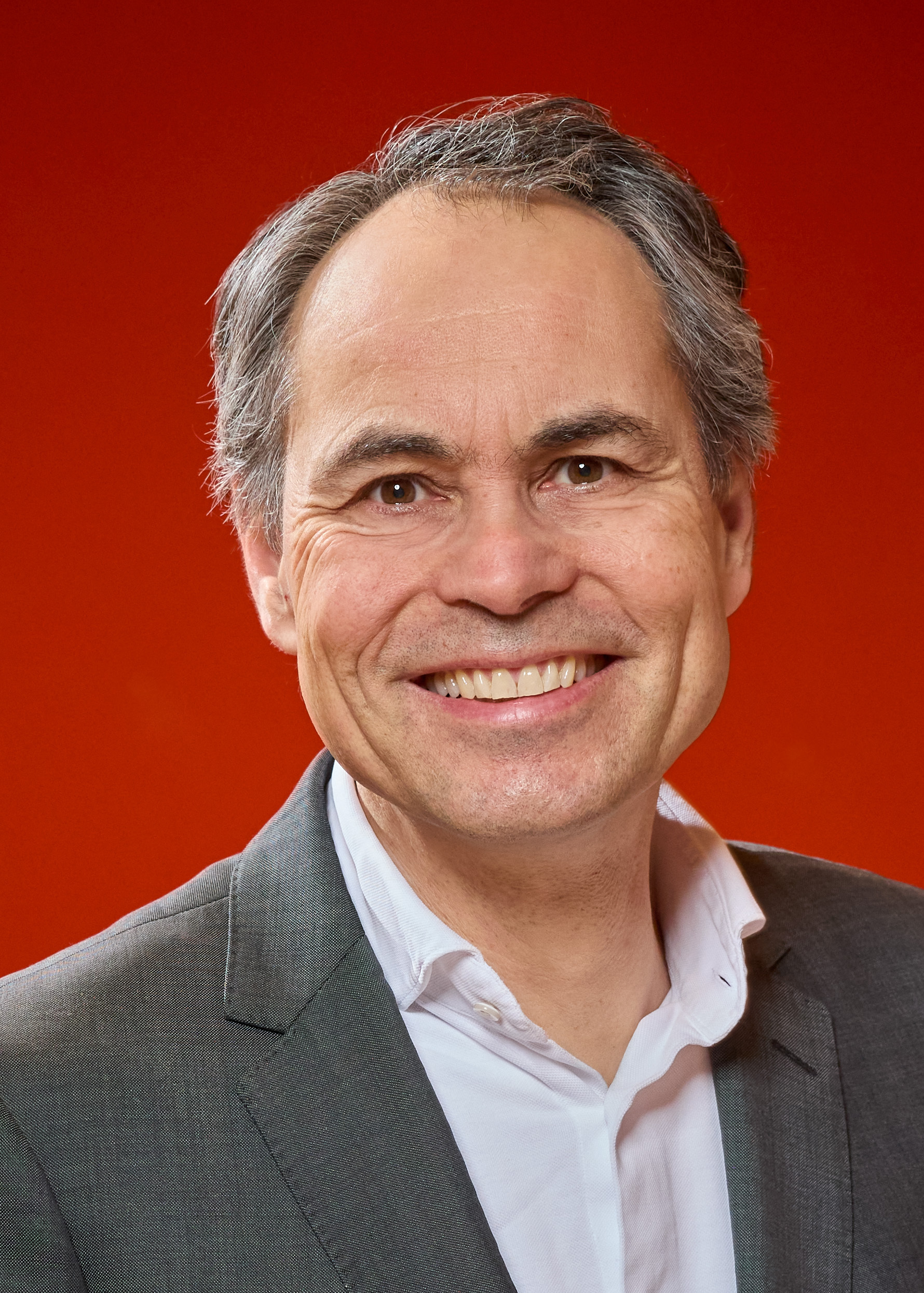
B.H.A.L. (Bart) Leenders, CTO (titular member)
(1969, Dutch, M)
Bart Leenders joined the Executive Board as a titular member on 1 November 2025, becoming Gasunie’s Chief Technical Officer (CTO). He has been appointed for a period of four years.
As of 1 November 2025, Bart Leenders heads the Procurement & Supply Chain, Safety, Asset Strategy, Asset Data & Environment and Large Projects departments.
Leenders started his career at Neste Netherlands in Rotterdam and has held several senior management positions. In his most recent role before joining Gasunie, he was in charge of a department that worked to improve the performance at Neste’s refineries worldwide. Leenders studied Mechanical Engineering at Delft University of Technology, specialising in measurement and control.
Other positions
- None
Executive Board members who left in 2025
A.J. (Jan) Boekelman, CFO
(1959, Dutch, M)
Jan Boekelman was appointed as interim CFO and member of the Executive Board on 11 February 2025 and stepped down on 31 December 2025.
On the Executive Board, he was responsible for the financial policy and the associated rendering of account to the Audit Committee and the Supervisory Board.
Boekelman studied Econometrics at the University of Amsterdam and completed advanced management programmes at the London Business School, INSEAD and Wharton.
Other positions
- Member of the Supervisory Board, Chair of the Audit Committee and Member of the Investment Committee, Oasen (water company)
- Member of the Supervisory Board, financial portfolio, SVP (Purmerend district heating)
- Board member, Chair of the Finance, Audit and Risk Committee, Aluminium Stewardship Initiative, Melbourne
- Board Member and Treasurer, Chimbo Foundation
B.J. (Bart Jan) Hoevers, CTO (titular member)
(1971, Dutch, M)
Bart Jan Hoevers joined the Executive Board as a titular member on 1 September 2017 and was reappointed on 1 September 2021. He stepped down on 1 September 2025 upon termination of his second term.
On the Executive Board, Bart Jan Hoevers was responsible for the Asset Management, Operations, IT and GTS focus areas.
Bart Jan Hoevers had been working at Gasunie since 2007. Prior to joining Gasunie, he worked at the Dutch Ministry of Finance, where he specialised in state holdings, and at the Dutch central bank (DNB). Hoevers studied Monetary Economics at the University of Groningen.
Other positions
- Member of Members’ Council, Netbeheer Nederland
- Board member, European Network of Transmission System Operators for Gas
- Chair of the Supervisory Board, Beheerder Afsprakensstelsel (BAS) B.V.
J. (Janneke) Hermes, CFO
(1978, Dutch, F)
Janneke Hermes was appointed as Gasunie’s CFO and member of the Executive Board on 1 October 2019. She was reappointed on 1 October 2023. She stepped down on 11 February 2025.
Janneke Hermes had held various managerial positions at Gasunie since 2005. Hermes studied Econometrics at the University of Groningen and attended the New Board Program at Nyenrode Business University.
Other positions
- Member of the Supervisory Board, Openbaar Onderwijs Groningen
- Member of the faculty supervisory board, Executive Master of Finance & Control, University of Groningen
Composition of the Supervisory Board
D.M. (Diederik) Samsom
(Chair of the Supervisory Board)
(1971, Dutch, M)
Date of first appointment: 1 July 2024
First term ends in 2028 (AGM)
Member of the Remuneration, Selection & Appointment Committee
Other board positions
- Chair of the Construction and Engineering Top Consortium for Knowledge and Innovation (TKI) (since 1 July 2025)
- Member of the Supervisory Board, Naturalis
- Member of the Sustainability Advisory Board, Van Oord
- Member of the Advisory Board, Elysian Aircraft
- Member of the Advisory Board, Return Storage Energy
- Member of the Advisory Board, Renergy Egypt
T.H.J.J. (Tim) van der Hagen
(Vice-Chair of the Supervisory Board)
(1959, Dutch, M)
Date of first appointment: 1 April 2023
First term ends in 2027 (AGM)
Member of the Remuneration, Selection & Appointment Committee
Other board positions
- Professor of Nuclear Reactor Physics at TU Delft
- Member of the Supervisory Board, Theater De Veste, Delft
C. (Carolina) Wielinga RA
(1970, Dutch, F)
Date of first appointment: 15 April 2019
Reappointment date: 29 March 2023 (AGM)
Second term ends in 2027 (AGM)
Chair of the Audit Committee
Other board positions
- Chair of the Supervisory Board, NX Filtration
- Member of the Supervisory Board, Royal A-Ware Food Group
J. (Johannes) Meier
(1963, German, M)
Date of first appointment: 1 September 2021
Reappointment date: 1 September 2025 (AGM)
Second term ends in 2029 (AGM)
Member of the Audit Committee
Other board positions
- CEO and founder, Xi GmbH
- Non-executive Director, New Work SE (until 24 June 2025)
- Chair of the Advisory Board, Stiftung Mercator
- Member of the Advisory Board, Meridian Stiftung
- Board member, UNICEF Germany
A.S. (Ate) Visser
(1956, Dutch, M)
Date of first appointment: 6 July 2018
Reappointment date: 29 March 2022 (AGM)
Second term ends in 2026 (AGM)
Member of the Audit Committee
Other board positions
- Member of the Executive Advisory Council, RLG International Inc.
- Director, Immaterial Ltd.
- Chair of the Board, Recircle Ltd
- Member of the Advisory Board, NL Space Campus
S.F.L. (Séverine) Baudic
(1974, French, F)
Date of first appointment: 27 March 2025
First term ends in 2029
Member of the Audit Committee
Other board positions
- Chief Executive Officer, Ekwil
A.L.M. (Anja) Mutsaers
(1970, Dutch, F)
Date of first appointment: 1 December 2021
Reappointment date: 1 December 2025 (AGM)
Second term ends in 2029 (AGM)
Chair of the Remuneration, Selection and Appointment Committee
Other board positions
Other board and external positions
- Lawyer and partner at the De Brauw Blackstone Westbroek law firm (until the end of February 2025)
- Member of the Supervisory Board, Ace Innovation Holding B.V. (Huisman Equipment)
- Non-executive member of the board of The Magnum Ice Cream Company
- Member of the Supervisory Board, Het Concertgebouw
- Deputy member of the Management Board, EU Agency for Fundamental Rights
- Lecturer, Vrije Universiteit, Amsterdam
- Lecturer, Erasmus University, Rotterdam
G.A.J. (Guido) Dubbeld
(1971, Dutch, M)
Date of first appointment: 4 March 2024
Member of the Audit Committee
Guido Dubbeld stepped down from the Supervisory Board on 1 October 2025.
Other board positions
- CFO Power2X B.V.
- Member of the Executive Committee, Stichting Tijdelijk Noodfonds Energie
- Consultant, Nederlandse Bedrijven Raad
- Member of the Supervisory Board and Chair of the Audit Committee, Invest International
- Member of the Supervisory Board and Chair of the Audit Committee, RET
- Member of the Advisory Board, Salacia Solutions
- Lay judge (Raad) at the Enterprise Chamber of the Amsterdam Court of Appeal
- Member of the Investment Committee, ValueFactory Ventures
- Director/shareholder, OxyNobel
- Consultant, Virida Capital Management
- Consultant, Dispatch Gridservices
Supervisory Board competency matrix
| Diederik Samsom (chair) |
Tim van der Hagen (member) |
Ate Visser (member) |
Anja Mutsaers (member) |
Johannes Meier (member) |
Carolina Wielinga (member) |
Severine Baudic (member) |
|
|---|---|---|---|---|---|---|---|
| Gender | M | M | M | V | M | V | V |
| Date of birth | 1971 | 1959 | 1956 | 1970 | 1963 | 1970 | 1974 |
| Nationality | Dutch | Dutch | Dutch | Dutch | German | Dutch | French |
| Expertise | |||||||
| Executive Board / Supervisory Board | X | X | X | X | X | X | X |
| Network, infrastructure (large projects): project control, execution, technical aspects | X | X | |||||
| Network, infrastructure (large projects): finance, budgeting, risk assessment, third party agreements | X | X | X | X | |||
| Safety expertise | X | X | X | ||||
| Public stakeholders | X | X | X | X | |||
| Energy sector and energy transition | X | X | X | X | X | ||
| Security of supply | X | X | |||||
| Finance | X | X | X | ||||
| Corporate social responsibility | X | X | X | X | |||
| Digital business processes | X | X | |||||
| Cyber security | X | X | |||||
| Technology and innovation | X | X | X | X | |||
| Legal & governance | X |
Report of the Supervisory Board
2025 was the year when the rule of law-based world order, built after the horrors of two world wars, became something we can no longer take for granted. In particular, but not exclusively, the behaviour of the country that was our most important ally during the past century, the United States, has brought unprecedented disruption to the international legal order. While it is impossible to predict the exact scope and impact of this upheaval at this time, it is clear that the European Union must urgently adapt to a new reality where it can no longer rely on its once-undeniable ally. Europe’s soft power of diplomacy, law and trade, which until now has driven the strength and influence of our continent, must be rapidly supplemented with far greater resilience and strategic autonomy.
Energy plays a key role in this. In a more hostile geopolitical climate, Europe must, for the good of its people and the future of its industry, end its overdependence on fossil fuels from only a few foreign suppliers and work towards its own affordable, reliable and clean energy supply. Fortunately, this is not an entirely new realisation. It means that the efforts initiated after Russia’s invasion of Ukraine and given a political boost by the Draghi Report must be accelerated and scaled up. The Netherlands and Germany, with their economic size, industrial base and strategic location, play a crucial role in this. Within this context and in collaboration with all relevant stakeholders, Gasunie assumes full responsibility for doing its part in the necessary transition to a resilient and sustainable energy system.
Against this backdrop, the organisation has proven itself to be a reliable partner for the Netherlands and north-western Europe over the past year: solid in day-to-day operations, agile where needed, and taking clear steps towards a future-proof energy system without compromising the robustness of the existing system. In the coming year, Gasunie will continue to invest in the resilience of natural gas supply and transport. And for the first time in its history, Gasunie will also transport other molecules on a large scale.
The new organisational structure, with five Executive Board members and six business lines, which went live on 1 January 2026, is visibly having the intended effect: ownership is more clearly allocated, decisions are made more quickly and there is a better rhythm in the way we work.
Plan implementation in 2025
In 2025, the Supervisory Board closely monitored the progress made on the business plan. In Germany, investment proposals were approved to facilitate the transport of natural gas from LNG terminals, which is a key link in the robustness of the European system. In addition, we have approved preparation budgets, among other things, for the possible extension of EemsEnergyTerminal’s operational period, for electrification of a German compression station and for further development of the Delta Rhine Corridor. The Supervisory Board focused particularly on the development of hydrogen networks in the Netherlands and Germany, CO2 transport and storage as part of the Porthos, Aramis and CO2Next projects, and the WarmtelinQ heat network. In this respect, the Supervisory Board looked especially at financial controls and quality assurance of project preparation in the transition towards actual implementation. We have seen clear improvement in the way Gasunie approaches these large projects. We see a consistent approach across these topics: Gasunie works both on security of supply and the energy transition.
Against the backdrop of increasing geopolitical tensions, the Supervisory Board also placed additional emphasis on resilience and (cyber)security, redundancy in critical assets and safeguarding continuity in highly uncertain times.
2026-2028 business plan
The 2026–2028 business plan, which was approved in December 2025, provides for an investment programme totalling approximately € 10.5 billion through to 2030. Around three quarters of this amount will go to energy transition projects, while one quarter has been earmarked for natural gas and LNG infrastructure to ensure security of supply. The Supervisory Board extensively and carefully reviewed the underlying assumptions, risks and financial preconditions.
At the end of 2025, Gasunie reached a preliminary agreement with ACM and market parties regarding the new regulatory period. This agreement is key to the predictability of GTS’s network tariffs. Uncertainty over tariffs for (as yet) unregulated activities, such as hydrogen and CCS, continues to be inseparably linked to a long-term investment agenda. In 2025, Gasunie also worked on its ability to provide greater certainty about future tariffs in the longer term.
Contribution towards security of supply
Security of supply remains a crucial pillar of a robust energy system. The decisions to invest in expanding LNG capacity at Gate Terminal and in the German ETL 182 pipeline contribute directly to security of supply.
The Supervisory Board also takes into account the broader context, such as the physical safety of infrastructure, cyber threats, market volatility and changes to international LNG flows. Gasunie operates within this reality with discipline and professionalism. We have observed this both in the implementation of projects and in GTS’s advice to the Ministry of Climate Policy and Green Growth on matters such as security of supply.
Contribution to the energy transition
The year 2025 again showed that the energy transition is by no means a linear process. Where the world puts the brakes on progress in some areas, new opportunities arise elsewhere. The Supervisory Board commends Gasunie’s chosen approach because it strikes a balance between determination in pursuing the goal and pragmatism in how to get there and what resources to use. It is becoming increasingly clear that energy infrastructures, such as those for hydrogen, electricity, CO2, heat and natural gas, need to be developed in an integrated manner. System integration is decisive for a reliable and affordable future energy system.
Gasunie features prominently in the public and political debate on Dutch and German energy system integration. The Supervisory Board welcomes this prominence wholeheartedly. The energy transition will only truly take off when industry also starts to invest in it and we start seeing market dynamics emerge. Gasunie is taking responsibility for its part of the energy transition and working together with all stakeholders, but who will take control to make sure there will actually be a market?
The international hydrogen market is developing, although at a slower pace than was expected a few years ago. Under these circumstances, it is logical that blue hydrogen, alongside green hydrogen, can play a role in the transitional phase, partly from the perspectives of affordability and system development.
Import flows using ammonia or other carriers are becoming increasingly important, while progress on Gasunie’s own projects remains crucial. The Supervisory Board has seen significant progress in the development of the Dutch hydrogen network, including the preparations for cross-border connections and systematic planning. The next steps in the HyStock project are also meaningful, as hydrogen storage is a prerequisite for a flexible energy system.
The role of natural gas will gradually diminish, but it will remain relevant over the coming decade. The Supervisory Board agrees that Gasunie must continue to balance both aims, i.e. security of supply today and infrastructure for tomorrow, more effectively than ever.
Safety
Safety remains a core value and a focus area for the Supervisory Board. The 2025 Safety Days, reports on process safety and the Safety Culture Ladder results all confirm that the organisation is taking significant measures to reduce risk and raise awareness. We urge the organisation to maintain its zero-accident ambition, as it is both ambitious and appropriate given Gasunie’s responsibility. We recognise that Gasunie’s focus on safety awareness is valuable and yields results, and wholeheartedly support further intensification of these efforts.
Consultations with the Works Council
Like in previous years, the Supervisory Board had frequent meetings with the Works Council in 2025. Our relationship with the Works Council is characterised by openness and constructive discussions, covering topics such as culture, the new organisational model and dialogue between the Works Council and the Supervisory Board. These discussions provide us with valuable insight into what is happening within the organisation. Once a year, the Supervisory Board, Works Council and Executive Board hold a joint knowledge session.
Consultations with the shareholder
We had several meetings with the Ministry of Finance, both informal ones and the usual formal ones in the spring and autumn. The shareholder plays a crucial role in major investment decisions, particularly when it comes to the hydrogen and CO2 value chains. We regard the relationship as open, constructive and focused on careful decision-making on Gasunie’s investment challenge.
2025 financial statements
We discussed the 2025 annual report, including the preparation of the Risk Management Statement that we are now required to issue under the Dutch Corporate Governance Code. Following a positive opinion from the Audit Committee and an unqualified opinion from EY, the Supervisory Board decided to submit the 2025 annual report to the general meeting of shareholders. We endorse the proposal to add the net profit to the reserves and not pay any dividend, given the scale of the investment challenge ahead.
Executive Board composition
In 2025, there were several changes on the Executive Board, which now consists of five members, i.e. a CEO, CFO, two COOs and a CTO. Jan Boekelman joined the Executive Board as interim CFO and director required by the articles of association on 11 February 2025. Marc van der Linden was appointed to the Executive Board as a titular member and COO on 1 September 2025. Bart Leenders joined as a titular member and became Gasunie’s CTO on 1 November 2025.
Additionally, Janneke Hermes stepped down as CFO on her own initiative effective 11 February 2025, having worked at Gasunie for almost 23 years, including five years as CFO. The Supervisory Board would like to extend its sincere gratitude to her for her many years of dedication to the company and valuable contribution to its development.
Bart Jan Hoevers stepped down on 1 September 2025 after completing his second term as a titular member of the Executive Board. He was the Executive Board member responsible for Asset Management, Operations, IT and GTS. The Supervisory Board thanks him for his contribution to this broad portfolio and his many years of dedicated service within the organisation.
The interim appointment of Jan Boekelman as CFO ended on 31 December 2025. We greatly appreciate the experience he brought and his contribution to the company.
The process to appoint a permanent CFO continued throughout 2025. On 15 January 2026, Katie Slipper joined the Executive Board as CFO.
The Supervisory Board notes with satisfaction that having this new and full-strength Executive Board in place means that the company’s continuity and the implementation of the strategic agenda for the coming years are secured.
Collaboration between the Supervisory Board and the Executive Board, and evaluations
Throughout the year, there was frequent and transparent collaboration between the Supervisory Board and the Executive Board to ensure careful decision-making. The size of the investment portfolio, progress made in energy transition projects and the new organisational structure were among the topics discussed regularly in both formal and informal meetings. In addition, there were numerous periodic informal meetings between Supervisory Board members and Executive Board members.
In 2025, the Supervisory Board evaluated both its own committees and its collaboration with the Executive Board. The performance of individual Executive Board members was reviewed against previously established targets set out in the remuneration framework. These performance reviews were conducted in accordance with the applicable procedures and provided us with insight into the functioning of governance processes.
Carried out under the guidance of an external facilitator, the evaluation of the Supervisory Board and its committees showed that the Supervisory Board is diverse, that the Supervisory Board members bring a range of perspectives and expertise, and that there is strong, professional collaboration among members. There is constructive and open debate with room for bold decision-making.
Focus areas include more effective preparation for meetings, additional time for reflection on strategic topics, and more efficient use of time for various representative duties.
Supervisory Board composition
The Supervisory Board saw two changes to its composition in 2025, as Séverine Baudic joined as of 27 March 2025 and Guido Dubbeld stepped down on his own initiative as of 1 October 2025. We would like to thank Guido for his valuable commitment and contribution to the Supervisory Board’s duties.
Any reappointments and changes within the committees proceeded within the applicable terms. We consider its composition to be balanced and appropriate for the required areas of expertise.
| Attendance at SB and committee meetings | SB | AC | BBC | Note |
|---|---|---|---|---|
| Diederik Samsom | 6 out of 6 | 5 out of 5 | ||
| Severine Baudic | 6 out of 6 | 4 out of 5 | date of first appointment 27 March 2025 | |
| Guido Dubbeld | 4 out of 4 | 4 out of 4 | date of resignation 1 October 2025 | |
| Tim van der Hagen | 6 out of 6 | 5 out of 5 | ||
| Johannes Meier | 6 out of 6 | 5 out of 5 | ||
| Anja Mutsaers | 6 out of 6 | 5 out of 5 | ||
| Ate Visser | 6 out of 6 | 5 out of 5 | ||
| Carolina Wielinga | 5,5 out of 6 | 4 out of 5 |
A word of thanks
In 2025, Gasunie reaffirmed its development from a natural gas transmission system operator into a broad energy infrastructure company, with integrated energy systems and international connections. This is an extensive transformation that requires sustained focus and commitment from both the Executive Board and the Supervisory Board. We proudly acknowledge the efforts, professionalism and dedication shown by everyone across Gasunie. Thanks to their work, Gasunie was able to take important steps in 2025, both in terms of security of supply and the development of the new energy system. This combination of ensuring stability for today and innovating for the future is what makes Gasunie such an important player in the current era.
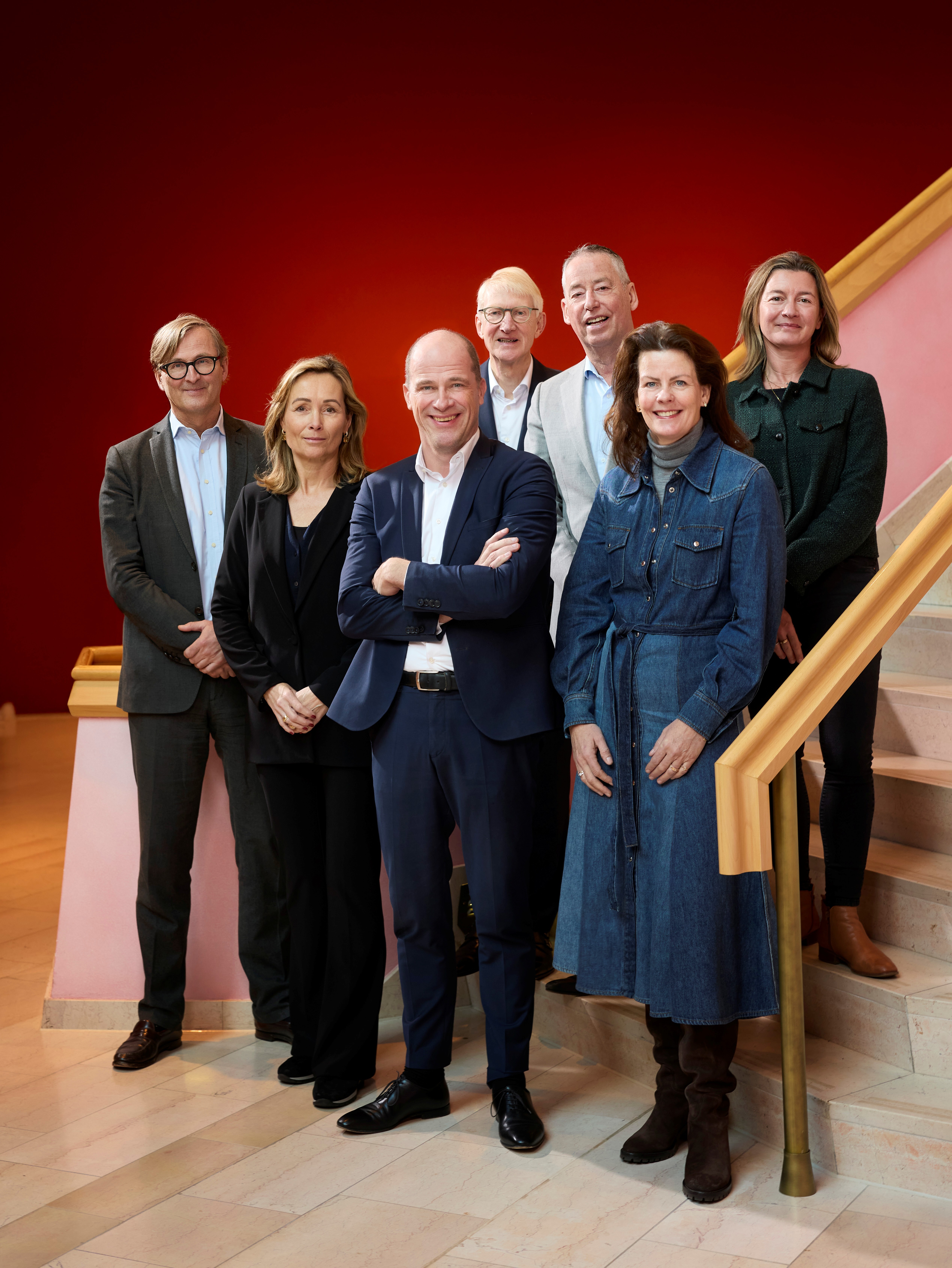
Groningen, March 2026
The Supervisory Board of N.V. Nederlandse Gasunie
Sustainability expertise of the Executive Board and Supervisory Board
The Executive Board has expertise in matters relating to sustainability and in recent years has taken final investment decisions for infrastructure projects that support the energy transition and involve hundreds of millions of euros. Before taking decisions, the Executive Board seeks extensive advice from experts within and outside Gasunie.
The Supervisory Board also has expertise in matters relating to sustainability. The board members are or have been engaged by companies in the energy/energy transition value chain and/or organisations that provide advice to this sector on these matters. As Head of Cabinet, the Chair of the Supervisory Board supported the (Dutch) European Commissioner for Climate Action for five years in the development of a Green Deal, a European Climate Act and the Carbon Border Adjustment Mechanism, a system for import duties on carbon-intensive products from countries without an emissions trading system.